Showing posts with label Kalahari Bushmen. Show all posts

Friday, November 2, 2018

The Price of Happiness Is Actually Free by Brendan Kaston


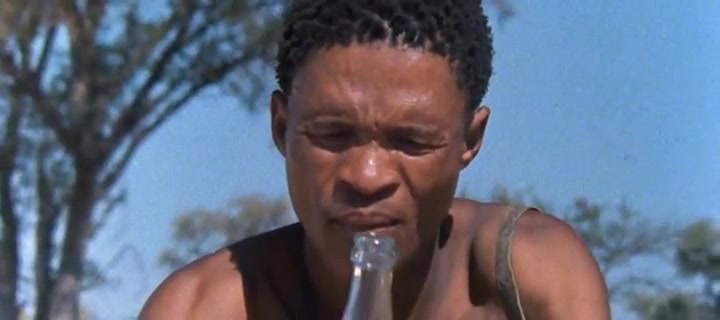
What if we lived life in a way in which we did not need to worry about the future, a world where living just meant existing without the stresses of our modern society? That is the existence of Xi in Jamie Uys’ film The Gods Must be Crazy. The Bushmen are living in the harsh Kalahari Desert when one day Western civilization invades his home in the form of a glass Coke bottle, which brings a lot of good to the members of Xi’s tribe. However, it also brings jealousy, anger, and violence (emotions the tribe has never had to face before). Without hesitation, Xi decides to expel the “evil thing” from the earth in order to bring his tribe back to the peaceful way it once was. On his journey, he encounters and explores Western civilization’s hectic ways. However, at the end of his adventure, Xi does not adapt any part of Western culture into his. Xi and the Bushmen make the decision to live without the technology of modern society because they realize that they value real happiness over alleged progress.


The tribe’s rejection of the Coke bottle is their rejection of Western society. At first, the Bushmen see the bottle as a gift from the Gods, and the Gods have only given them good things. The Bushmen soon realize that this is not the entirely the positive force they believed it to be. The tribe huddles around the fire silently, dreading what else it will bring. However, the whole tribe comes to the same conclusion: they do not need the “evil thing” that they have grown to depend on. Xi understands that his people have two choices just as primitive societies did: progress or happiness. Our ancestors chose the former, and the world has expanded and been developed into the concrete jungles we call home today. Xi and his tribe make the opposite choice. They value their happiness much more than they value ease of life. While our society may have all the tools to live with minimal effort, many of us are not truly happy with our roles. Many are forced into lackluster jobs in order to make ends meet while monotonous routines drain them until they can no longer feel fulfilled in the workplace. On the other hand, the Bushmen are happy even though they live in one of the most inhospitable locations on the planet. Xi and the other Bushmen appreciated how much easier the bottle made their lives, but that is not why they rejected progress. “They repudiated the jealousy and materialism of the West” (Gordon).


Western society choose the path of progress, and while it has created an amazing world of leisure, it has also created a society that has not stop to smell the roses. Our cities are proof that we could not adapt to living life in nature, so we made nature adapt to us. However, now that we have access to fresh running water and almost any kind of food we could want with a short walk to our refrigerators, humanity has lost its instinctual need to fight to survive. A psychologist, Abraham Harold Maslow, studied human nature and how we address certain needs that are required to have successful and fulfilling lives.Maslow stated that people are motivated to achieve certain needs and that some needs take precedence over others. Our most basic need is for physical survival, and this will be the first thing that motivates our behavior. Once that level is fulfilled the next level up is what motivates us, and so on” (McLeod, par. 2).


The problem is that Western society has overcome our basic needs, making our foundation much smaller and weaker. Without having to work too hard for food, water, or shelter, we see our psychological needs as basic needs for happiness. Tirelessly working each and every day makes us, “crack under the constant pressure of the routine monotony of modern life” (Knight). That is why Kate, the journalist, decides to move out to the small Botswanan village in order to teach (Uys 0:25:53). While she is looking for something different, she is also unhappy with the state of her life. By moving to the Botswanan village, she is able to reinvigorate herself. She has students to care for; she meets Andrew, her eventual love interest; and she reaches self-actualization by immersing herself in the locals’ way of life. Kate’s transition proves that distancing oneself from the constant stressors of Western civilization can increase one’s quality of life.


While some may argue that Kate’s eventual happiness would not bloom as it did in the film, it has been proven to work. Henry David Thoreau was a naturalist who decided to seclude himself from modern American society in 1845. He understood that the path to a greater understanding of our life on earth is through an understanding of the natural world around us and of which we are part:

We can never have enough of nature. We must be refreshed by the sight of inexhaustible vigor, vast and Titanic features, the sea-coast with its wrecks, the wilderness with its living and its decaying trees, the thunder cloud, and the rain which lasts three weeks and produces freshets. We need to witness our own limits transgressed, and some life pasturing freely where we never wander — I suppose that what in other men is religion is in me love of nature (http://www.walden.org/thoreau/ par. 4).

His experience in the woods mirrors the lives of the native people of the Kalahari. Nature is a magical gift to them as it should be to all who are willing to stop and open their senses. Life may not be as easy when one immerses themselves in nature; however, one is able to focus on what is truly important to them without the distractions of never ending deadlines and repetitious routines. In Walden he writes, “Simplicity, simplicity, simplicity! I say, let your affairs be as two or three, and not a hundred or a thousand; instead of a million count half a dozen, and keep your accounts on your thumb-nail” (Thoreau 82). Thoreau is praising the simple life. He discovered that the hustle and bustle of modern life made a formula for stress and unhappiness, a formula that he rejected in order to find his own happiness.


The Bushmen are content with their lives no matter how difficult things may be. They see their way of life as complete without technology. They work hard to survive, and they are happy to be a part of the tribe. This contrast with modern society is shown in our levels of stress and overall happiness:

Modern society equals fullness with meaning so if schedules are always booked then life must be wonderful. A busy schedule blocks and shoves down unpleasant feelings brought on by difficult to answer questions. Those feelings, however, do not go away, but instead manifest themselves in the rampant outbreak of depression. This is why the Bushmen’s freedom is so important; they have the time to reflect and engage with tough topics. It is not as though they are always having deep philosophical discussions, but they are able to if need be (Morrill par. 7).

The Bushmen’s minds are sounder due to their natural lifestyle. They think clearly about whatever obstacles or issues are thrown, or dropped, their way. When one of the most important life changing tools falls to their feet they are able to think rationally about the pros and cons of having such power. The Bushmen decided that while progress may make their lives easier, it would not make them happier.


The Bushmen who are seen as primitive compared to industrialized western society are actually much wiser than their stressed-out neighbors. They understand the importance of living in the moment. In their eyes God has given them all they need, and they are eternally grateful. The bottle was a test, one which they believed they passed. Xi’s decision to throw the bottle off the end of the earth was accepted by the whole community because their tribe’s values are different then ours: they value happiness over easiness. Until our culture can choose peace of mind over higher productivity, we will never self-actualize like the Bushmen of the Kalahari Dessert.


Works Cited


               Gordon, Paul Kirpal. Class Discussion. April 4, 2018.

“Henry David Thoreau.” The Walden Woods Project, www.walden.org/thoreau/.

Knight, Lindsay. Class Discussion. February 12, 2018.

Mcleod, Saul. “Maslow's Hierarchy of Needs.” Simply Psychology, Simply Psychology,

2017, www.simplypsychology.org/maslow.html.

Morrill, Morgan. “The Ironic Hospitality of the Kalahari Desert.” Taking Giant Steps

Press, Paul Kirpal Gordon, 14 Mar. 2018, giantstepspress.blogspot.com/search?q=the+ironic+hospitality.

Thoreau, Henry David, 1817-1862. Walden; And, Resistance to Civil Government:

Authoritative Texts, Thoreau's Journal, Reviews, and Essays in Criticism. New York: Norton, 1992. Print.

Uys, Jamie, director. The Gods Must Be Crazy. Perf. N!xau, Marius Weyers, and Sandra

Prinsloo. 20th Century Fox., 13 July. 1984. Film.

“Where I Lived and What I Lived For, a Chapter in Walden by Henry David

Thoreau.” truecharecteinnature.weebly.com/where-i-lived-and-what-i-lived-for-a-chapter-in-walden-by-henry-david-thoreau.html.

Wednesday, October 17, 2018

A Life Worth Living: Reflections on "The Gods Must Be Crazy" by Danny Giancioppo


The sun peeked through the trees, and birds chirped softly against the whistling wind as the last of the long, August days came to a close. My chest rose and fell heavily, as my eyes slowly but surely fogged up with warm and stinging tears. My voice trembled, my hands shook, and I stared right at my best friend, feeling exactly the same way, as we attempted to find the words to say goodbye for the first time in our lives. We would see each other again, and talk on the phone almost every day, but we still knew that this was the end of a chapter in our lives. So, as I mustered the strength, I told him he was my best friend in life, I loved him like a brother, and I’d miss him, and he said the same; the beautiful sadness of course was that we felt such grief then due to equally positive, if not more powerful, experiences in our past. It was this ability to love one another, even simply as friends, that so much raw emotion could arise, as well as so much good being done for one another. Looking back, I realize that this is the case in so many other scenarios, not the least of which is Jamie Uys’s The Gods Must Be Crazy. Whether it was Steyn, Kate, Mpudi, or even just Xi with all living things, they provided irrefutable evidence in their words and actions that love is not only a driving force for goodness, but a powerful enemy to evil, and through its strength one can find a life truly worth living.


It’s almost too glaringly obvious to say that there are good guys and bad guys in this movie, but the more interesting fact to explore is the way in which the characters are depicted as members on polar ends of the spectrum. The Kalahari Bushmen are characterized as being “pretty, dainty, small and graceful” (Uys, 1:33). They know only peace and an unselfish love for most, if not all, living things around them. They allow time for conversation, leisurely activities, and even when they work, they do so both happily and cooperatively. Additionally, when the Coke bottle falls to the earth and disrupts this contented and fulfilling lifestyle, the Bushmen know enough, and more specifically love one another enough, to openly discuss their issues with this “evil thing” and decide to be rid of it. This purity they share, and the strength found within it, is more than enough to combat the nefarious Coke bottle, and achieve their goal of removing it from the earth. Alternatively, however, those without such kind-hearted emotions come to less than positive outcomes.


Sam Boga, arguably the most blatant and dangerous antagonist of the film, holds very little love in his heart, at least when viewed through the perspective of how he treats those around him. Whether it be those who he crosses paths with, the children he takes hostage, or even the very men working for him, Sam Boga is consistently unhappy, shouting and barking orders in an almost crazed sort of tone. His disregard for the lives of essentially everyone other than himself leads to his ultimate downfall. In fact, it is because of the love the other characters share for one another, even in a general sense, that they are able to outwit Sam Boga. Kate’s devotion to keeping her students safe as well as Steyn, Mpudi, and Xi’s need to save both Kate and the students and their general trust in and care for each other allows them to overcome the ferocity of Sam Boga and his criminal underlings. Even relationships that are not perfect, such as Steyn and Kate, for instance, can maintain a level of love which defeats the thought that isolation is key. I would know.


My car came to a puttering halt, and as I unbuckled, and turned to face my oldest friend, who had been my neighbor since birth, I felt my stomach doing flips and swirls the likes of which would make a roller coaster seem like a carousel. We stepped outside, the stars shining through a clear August sky, and despite the warmth the night still provided, I could feel a bitter chill with my every move. For the first time in our lives, he and I hugged and promised we would see each other again soon. I told him he was my brother; not that he was like a brother, but that he was my brother. I was always the more openly emotional of the two of us, so he didn’t say much, but from what he did and from what I could see, I knew the feeling was mutual. And as I rode back to my friend’s house, where we had left just minutes before, I felt the same kind of sweet sting I’d feel in departing my best friend weeks later.


My mom once said to me: “You’re so close with the other guys, you hardly ever fight, but you and [my oldest friend] always argue. How can you say you’re really that close?” (Giancioppo, 2016). I understood her trepidation, but as I’d always tell her, close friends don’t argue that much, but brothers always bother each other and they always get over it. We fought all our lives, and constantly had ups and downs; we had periods of time where we would not want to even see each other, let alone talk. Sometimes it was my fault, other times his, and some issues were more serious than others, but all the same, despite almost everyone claiming disbelief we would ever fix things, we always did. We loved each other, even with all the complications through the road we walked, because we walked through it together. We always made things better, and better was always good enough to keep an almost nineteen-year friendship going strong. Yet, despite better being just that, good enough, it seems that for society as a whole, it never can be. Instead, the world strives for perfection through cultural conformity, and in that search finds only reluctance, emptiness, a lack of love, and thusly, a lack of strength.


As Morgan Morrill explained in her own essay, “The Ironic Hospitality of the Kalahari Desert,” society, or rather the “industrialized world,” is going through a “happiness famine” (Morrill, Par. 5). She states that even smiles are few and far between in the modern world, whereas the Kalahari Bushmen are living a much more joyful, albeit simpler kind of life. Morrill goes on to provide statistics of the rising rate of diagnosed individuals suffering with depression in the United States alone, and she claims it’s highly due to the stress humanity puts upon itself to further society rather than their own necessities in life. With such a lack of empathy and such a focus on success and progress, we allow ourselves neither the time nor the love for what really matters in this world: each other. “No wonder some people go off the rails a bit” (Uys, 8:08).


Speaking of going off the rails, the rather disconnected members of society in Nicolas Roeg’s Walkabout share a strikingly similar mindset. Morrill suggests that not only the urbanized members of The Gods Must Be Crazy do, but that many of us in the real world do as well. The father of the two children, who is arguably the most far gone of any character in the film, has such a distinct lack of love for his children, it’s painfully obvious: inappropriate glances at his daughter, attempting to kill both her and his son, and then taking his own life, all within a matter of minutes! Alternatively, the hunter, brother, and sister all come to care quite deeply for each other. Through this devotion to one another, they are able to travel a great distance, learn a great deal, and survive the dangers of the outback, all while forming a strong bond, and even enjoying themselves throughout. To be certain, this idea of love---and with that, a lack of it---carries over in a number of scenes and only exemplifies the power it may hold in either direction.


Life can be hard, and there is no getting around that. It can feel so easily like it gives more than it takes, and it is much easier to just fall into autopilot and leave emotion out of the equation altogether just to get by. However, if you allow yourself to open your heart and see the virtue in true love---not just romantic but familial and platonic as well---the world and those within it may in turn open themselves up to you. Just as Xi, a leader of the Bushmen, does with all he comes across, we too can use the power of love to drive us toward a better, more fulfilling life. So far as I’m concerned, doing so in my own life has brought me more than I could ever have asked for; it has given me a life worth living, filled with people worth loving. Not only has it made me a stronger person, but more importantly, loving has made me a better person more than any kind of hate or ignorance ever could. After all, better may not be perfect, but it’s good enough, and good enough is better than a life without love to begin with. When you carry such strength, you may find that’s all you ever need things to be: good enough.


Aaron Frongillo and author Danny Giancioppo


Works Cited


Giancioppo, Karen. Conversation. 2016.


Morrill, Morgan. “The Ironic Hospitality of the Kalahari Desert.” 

Taking Giant Steps. N.p., 14 Mar. 2018.


Roeg, Nicolas, Dir. Walkabout. 20th Century Fox, 1971, 


Uys, Jamie, Dir. The Gods Must Be Crazy. 20th Century Fox, 1980.


Wednesday, March 14, 2018

“The Ironic Hospitality of the Kalahari Desert” by Morgan Morrill


Today, members of the modern world rush past in a whirl of color and noise, too concerned with busy schedules rather than with their quality of life. People live their lives in a strict fashion with every minute of every day planned out. There is barely time to breath in this machine-like world with the amount of meetings and activities that everyone has written on to their calendars. This is an extreme way to live, but people brush it off believing that it is the only way.  After all, it is the new and improved method of advancing civilization. This image deeply contrasts with the lifestyle of the Kalahari Bushmen that Jamie Uys presents in his 1980 film, The Gods Must Be Crazy. Deep in the parched Kalahari Desert, these tribes live a simple life devoid of all modern improvements, yet they seem perfectly content. Is there more to life than endless to-do lists? Uys uses the Bushmen in his film to show the benefits of a laid-back lifestyle as opposed to the high-strung chaos of modern life.


When the movie beings, Uys sets up his comparison promptly. Sweet playful notes fill the background as images of African animals flash across the screen. The first people that are shown are the “pretty, dainty, small and graceful” (Uys, 1:33) Bushmen. They are all dark and slender, each with a wide smile on their face. Young and old members of the small tribe are seen helping one another, as well as laughing and playing. Though only 600 miles from a city, the Bushmen live in a completely different world where there is not evil nor vices to poison their lives. As the voiceover remarks, “They must be the most contented people in the world” (Uys, 2:54). The narrator treats this scene, and all other ones, as though the movie is a nature documentary. Most of the insights that the voice makes are over the top and used as a comedic tool. For example, the narrator makes it seem like the Bushmen have no problems in their lives, but that is a strong unlikelihood. The comments do, however, emphasize the fact that these people live a peaceful life and makes it glaringly obvious to the audience.


Just as the voiceover points out the tranquility of the Bushmen, it also illustrates the chaos of modern life. The opening cuts quickly from the joyful tribe of people to the hustle of a loud city with cars speeding along its roads like blood through veins. This is how Uys depicts what the narrator deems “civilized man” (Uys, multiple occasions): fast-paced, raucous, and utterly insane. The last descriptor becomes more apparent as the voice begins to describe the lifestyle of city people. He states that “civilized man refused to adapt himself to his environment, and instead he built his environment to suit him” (Uys, 6:12). Towers, cars, assembly lines, and other inventions whiz past to further prove his point. Not a single piece of nature is seen unless it has been mowed, trimmed, and pruned to perfection. The whole scene moves with a machine-like precision, stopping and starting at just the right times. Everything is by design. Once again these characteristics are emphasized on purpose just like with the Bushmen. The severity of order in the city is being used to make it obvious to the audience and easy to contrast with the ironic hospitality of the Kalahari Desert.


The biggest difference between the Bushmen’s world and that of civilized man were not the blatant alterations, but rather the overall feel of each place. As mentioned previously, the Bushmen all had large grins across their mouths; it is as if they were born with them in place. They have to work hard to survive in the desert, but their faces never falter and they still have time for fun. The Bushmen simply radiate happiness and viewers can sense the warmth these people give off. There is no such feeling with the modern world. Smiles are few and far between in their modern scene and no laughter is heard above the blaring car horns. Everyone keeps their heads down and a bland monotony settles throughout the streets. Despite having almost everything the Bushmen do not, modern man lacks one thing: happiness.


The happiness famine in the industrialized world is nothing new. Looking at worldwide statistics, one will find that the United States has one of the highest depression rates even though it is one of the most developed countries. About 1 in every 10 Americans suffers from depression and the number of people diagnosed increases by 20% every year (“Depression Statistics”). Why is this the case? What is the cause of the robotic population in Uys‘s film and the declining mental state of America? The movie hints at an explanation when the narrator remarks, “The more [civilized man] improved his surrounding to make his life easier, the more complicated he made it” (Uys, 6:26). Modern day people spend most of their time working in order to keep society running and before that children are shoved into schools to prepare for the work. Stress consumes the population as everyone scrabbles for that house with the picket fence which they never truly get to enjoy because work is always hanging over them. As the voiceover correctly points out, “No wonder some people go off the rails a bit” (Uys, 8:08). It is as though ‘civilized’ man is running inside of a wheel, believing that if they run hard enough they will get the treat just outside of their reach, when in reality they are exhausting themselves just to stay in the same place.


Not only are people working themselves to death, they are also addicted to the stress. Tim Kreider addresses this topic in his article, “The ‘Busy’ Trap.” He explains that people who are constantly busy, which includes most of the population, are that way “because of their own ambition or drive or anxiety, because they’re addicted to busyness and dread what they might have to face in its absence” (Kreider, par. 2). Society has come up with the notion that if a person is not running around 24 hours a day then something is terribly wrong. Standard work weeks are 40 hours, but that time is growing exponentially as the internet allows the population to bring work with them wherever they go, provided they can get a signal. It is not just adults who do this. Parents force full schedules on to their children under the pretense that it will get them ahead in life. In his article, “The Disease of Being Busy,” Omid Safi recalls how when he tried to set up a playdate between his daughter and the neighbor’s child the mother responded with this: “She has a 45-minute opening two and half weeks from now. The rest of the time it’s gymnastics, piano, and voice lessons. She’s just…. so busy” (Safi, par. 5). This toxic environment hell-bent on filling up everyone’s planners down to the last second is what produces the fast paced and apathetic society that Uys shows to his audience.


As opposed to the perpetually swamped lifestyle of modern man, the Kalahari Bushmen hold leisure time in high regard. In their small family groups or villages, these people spend a fair amount of time doing, well, nothing. Free time for all ages is available every day and they fill the time based upon actual desires. Children are also not given tasks until they are much older (“San People,” par. 10). These groups deal with something that civilized man appears to be deathly afraid of: unstructured time. Kreider describes the love of being busy as “a hedge against emptiness” (Kreider, par. 6). Modern society equals fullness with meaning so if schedules are always booked then life must be wonderful. A busy schedule blocks and shoves down unpleasant feelings brought on by difficult to answer questions. Those feelings, however, do not go away, but instead manifest themselves in the rampant outbreak of depression. This is why the Bushmen’s freedom is so important; they have the time to reflect and engage with tough topics. It is not as though they are always having deep philosophical discussions, but they are able to if need be. According to Kreider, “Idleness is not just a vacation, an indulgence or a vice; it is as indispensable to the brain as vitamin D is to the body, and deprived of it we suffer a mental affliction as disfiguring as rickets” (Kreider, par. 10). It is a simple thing, open time, but it makes all the difference and it is what allows the Bushmen to have a well-developed relationship with contentment.


Unstructured time is what will save the mental health of modern man.  It is clear enough that the way society is currently structured is detrimental to people of all ages and making them have a morbid attraction to being busy. Uys’s movie does provide an alternative model in the form of the Kalahari Bushmen. They are obviously much happier, despite living in one of the most unforgiving areas on the planet. The goal in the rehabilitation of civilized man, however, is not to relocate them all to the desert. Instead, specific alterations need to be made so that free time is not seen as a cancer to society, but rather a supplement. Certain laws and regulations have already been put into action and the results cannot be argued against. For example, Finland’s school system allots 75 minutes a day for recess and rarely gives homework. This extra time to grow and develop as a person has allowed Finnish students to graduate from high school at a rate of 93% and surpass all other countries on test scores (“There Is No Homework in Finland”). As for adults, France has only a 35 hour work week and has a law preventing workers from checking their work emails after 6 pm. The country is currently one of the top ten happiest countries in the world (Johnson, par. 2). It is clear by this data that free time is beneficial to the over worked, stressed, and tired population of civilized man.


The time to kick the addiction to busyness it now. Uys was aware of this problem when his movie came out almost 40 years ago. He saw the advantages of joy and leisure in the Kalahari Bushmen, but society has ignored its metal decline. Caught up in meetings, classes, and work, modern man has forgotten about its heart. Along the path to improvement, hearts and souls were left to deteriorate in the background, perpetually left off of anyone’s to-do list. Now, the only way to revive humanity from its emotionally diseased state is to nurture the self again. Time is a gift, not a menace breathing down everyone’s neck till they meet the deadline, and it should be celebrated. That is when people get to know themselves and it is where possibility lies. It is time to put down the paperwork, turn off cell phones, and stop being so busy. Life is a meeting that cannot be missed and there is no way to reschedule it when the time has passed.


Works Cited

“Depression Statistics” Infographic. Healthline. Health On The Net. 2012. Web. 2 April. 2017.

Johnson, John. “France bans work e-mail after 6 p.m.” USA Today. Gannett Satellite         Information Network, LLC. 11 April. 2014. Web. 2 April. 2017.

Kreider, Tim. “The ‘Busy’ Trap.” The New York Times. The New York Times Company., 30 June.    2012. Web. 2 April. 2017

Safi, Omid. “The Disease of Being Busy.” On Being. Disqus., 6 Nov. 2014. Web. 2 April. 2017.

“San People.” Wikipedia. MediaWiki. 23 March. 2017. Web. 2 April 2017

The Gods Must Be Crazy. Dir. Jamie Uys. Perf. N!xau, Marius Weyers, and Sandra Prinsloo. 20th   Century Fox., 13 July. 1984. Film.

“There’s No Homework In Finland.” Infographic. NeoMam Studios. NeoMam Studios. 4 March.   2013. Web. 2 April. 2017.


Tuesday, February 6, 2018

"Putting Masculinity on the Chopping Block" by Benny Gottwald


In raising me, my father gave me a simple privilege and spared me a tremendous task: he always allowed me to cry and never ordered me to be a man.

“Everybody gets sad or scared sometimes,” he would tell me consolingly. He had no impulse to shout nor scold, let alone demand that I be stoic and unassailable. Instead, my father taught me to channel my negative energy, not to ignore it; to interpret my emotions, not to block them out; to express myself because I finally understand my feelings, not because I have been captive to them. On the other hand, I also recognize the rarity of my father’s method—a style of parenting liberated from the code of masculinity, seeking a higher plateau of emotional literacy and universal principle—and I see that many fathers continue to steer their sons towards old-school machismo. From generation to generation, the male code of conduct, along with its misogynistic and emotional handicaps, continues to intertwine itself within the status quo. For the sake of every man—relentlessly driven by society to be the alpha male, to hide his sensitivity, to never appear vulnerable—masculinity needs a new perspective.

Film director Jamie Uys offers such a perspective in his 1980 film, The Gods Must Be Crazy. While masculinity is just one of the many undertones of the film’s shifty and enthralling plot, Uys’ depiction of the social climate of 1980’s South Africa imposes a much needed juxtaposition upon the concept of the male. The classic film begins, as veteran film critic Roger Ebert observes, “. . . with a Coke bottle falling from the heavens” (Ebert par. 1). Tossed out of plane and into the undergrowth of the Kalahari Desert, the ubiquitous byproduct of the civilized world becomes both a tool and an object of jealousy when a Xhosa-speaking Bushman, Xi, discovers it and brings it to his tribe. Convinced that the object is a gift from their gods, Xi and his family quickly find many uses for the bottle: as a tool for curing snakeskin, as a mallet, even as a musical instrument. “But the gods had been careless,” the film’s voiceover describes, “They had sent only one. Now, for the first time in their lives, here was a thing which could not be shared. . . unfamiliar emotions began to stir, a feeling of wanting to own, of not wanting to share. Other new things came: anger, jealousy, hate and violence” (Uys 10:25). Seeing this tension build, Xi, played by indigenous actor N!xau, resolves to walk for days on end, to what the Bushmen call “the end of the Earth,” in order to throw the bottle into the sea (Uys 15:02).

As Xi’s journey unfolds, Uys playfully ensures that it is joined by three other characters, each with their own progressing storyline: the communist gang leader, Sam Boga, on the run after orchestrating a botched assassination attempt; a female journalist, Kate Thompson, who decides to journey into Botswana to become a school teacher; and a nervous, self-conscious microbiologist, Andrew Steyn, collecting animal droppings in the Kalahari for the sake of science. Viewers of Uys’ film bear witness to the complex social and political terrain of South Africa during the Apartheid, yet they also see masculinity’s chokehold on the society. Topics like self-expression, manliness, and the treatment of women are all commented on. The characters in The Gods Must Be Crazy, especially the male ones, embody differing takes on how men should act, and how they should behave around women. The issues they create, and the manner in which those issues are resolved, critique and expose masculinity, putting it exactly where it should be: on the chopping block.

Tony Porter was one of the first men to give such a crucial critique of masculinity. In his 2010 Ted talk, A Call to Men, he brought to the chopping block what he called “the collective socialization of men,” otherwise known as the “man box.” He began his talk with his story: “Growing up as a boy, we were taught that men had to be tough, had to be strong, had to be courageous, dominating — no pain, no emotions, with the exception of anger — and definitely no fear; that men are in charge, which means women are not” (Porter 0:11). As he elucidates the social climate of his birthplace, Porter in turn describes the societal context of the male code—the ramifications of which also apply to 1980’s South Africa and, by extension, the setting of Jamie Uys’ film.
Of the characters in The Gods Must Be Crazy, Andrew Steyn contrasts most blatantly against the physical and emotional backdrop of his surroundings. While he is incredibly knowledgeable of the Kalahari environment, his scientific acumen is not matched with a strong sense of self or of others. One day, while Andrew is at his campground—his aide and companion, Mpudi, hard at work fixing their Land Rover—a Christian reverend from a nearby town arrives. He tells Steyn that a new schoolteacher is coming to Botswana and implores Steyn to drive through the African desert to pick her up. Being a capable person who understands of the lay of the land, Andrew is only reluctant for one reason: “Reverend,” he says, “I’m very awkward around women.” When the reverend replies, “Aren’t we all,” Steyn elaborates, “No, it’s not like that. When I’m in the presence of a lady, my brain switches off or something. I turn into a complete idiot” (Uys 29:10). While Steyn eventually acquiesces, Uys brings his awkwardness around Kate to the forefront of their interactions. His inability to purport himself normally complicates their every encounter in some way; it creates sexual tension, and even portrays Andrew as clumsy and dumb. In reality, he is merely trying to accommodate Kate in an environment that she is not accustomed to. Nonetheless, the viewer sees his efforts as being inexperienced incidents of amateur courtship.
In and of themselves, the hijinks that occur between Andrew and Kate offer an interesting take on masculinity and the social dynamic of masculine and feminine interaction. However, this is not the entirety of Uys’ depiction of manhood; he further complicates the scenario with another male character. When the difficult Kalahari landscape takes its toll on Andrew’s Land Rover, he and Kate are forced to camp out for a night. The delay concerns the reverend, who sends Jack Hind to retrieve Kate. Jack is presented in many ways as the antithesis of Andrew—a tan, suave, enterprising safari guide who drives a double-decker tour bus with a built-in bar and speaker system. He arrives the next day to retrieve Kate, and his presence immediately changes the power structure of the film’s characters. Viewers who have been shown Andrew’s immense capacity for intelligence, curiosity, and skill have their attention redirected in an unwelcoming way.
Jack seems to have everything he wants, and carries himself accordingly. Uys shows him taking Kate by the arm as he guides her out of Andrew’s car, asking her if she would care to “travel in style for a change,” pouring her a drink, all in an overtly macho fashion. He speaks and acts as if he is fresh, flawless, and fearless—all of these being traits considered optimal in a man. However, Uys doesn’t spare him an ego either; his sense of unswallowable pride dominates his character. This egoism can be heard best in the rodomontade he utters to Kate when they part ways from Andrew and Mpudi: “By the way, I am Jack Hind. The Reverend's worried. He got to me on the short-wave, so I offered to look for you and that was very sweet of me” (Uys 59:41).
The inflation of Jack’s esteem and the deflation of Andrew’s owe themselves to the same concept: the code of masculinity, the “man box.” Not only do cultural norms of machismo dictate how men see themselves and interact with other men, they stereotype the way in which men treat women too. However, when the circumstances of masculinity are liberated from the gender norms that conceal them, one recognizes the fact that no distinction needs to be made between how the genders are individually treated. Instead, it is best to regard people simply as human beings, with the categories of gender relieved of their influences. The misapprehension that men must talk differently and act differently in the presence of other men versus the presence of women is a mere figment of culture—the sort of culture which Tony Porter asserts should be done away with. In his TED Talk, he also commented on the detrimental associations made by gender:
I can remember speaking to a 12-year-old boy, a football player, and I asked him, I said, "How would you feel if, in front of all the players, your coach told you were playing like a girl?" Now I expected him to say something like, I'd be sad; I'd be mad; I'd be angry, or something like that. No, the boy said to me, "It would destroy me." And I said to myself, "God, if it would destroy him to be called a girl, what are we then teaching him about girls? [Porter 4:42]

There is no way to answer Porter’s question kindly. The unfortunate truth is that the socialization of men can represent harmful and misogynistic values, such as the ones that surface during one conversation between Andrew and Mpudi. As Andrew mentally rehearses his plan to apologize to Kate for his awkwardness, the two discuss the ‘right way’ to act around women. Mpudi mentions his seven wives, and an illuminating dialogue ensues:

Mpudi: You've gotta smile, man, and tell her she looks good. 

Steyn: How come suddenly you're an expert on women? 

Mpudi: I got seven wives. How many you got? 

Steyn: So why aren't you at home with your seven wives? 

Mpudi: I know how to marry them. Nobody knows how to live with them. 

Steyn: So, what did you marry them for? 

Mpudi: Someday I have to tell you the facts of life. [Uys 1:03:51]

While Mpudi’s beliefs (and the beliefs of his culture at large) may see these norms as ‘facts of life,’ the philosopher Simone de Beauvoir saw them as the paralyzing circumstances of women in society. In her book, The Second Sex, she made an observation that incidentally combines two of Uys’ plot points—Jack Hind’s efforts to pamper Kate, and Mpudi’s marriage to seven wives—proving them to be two sides of the same coin:

Women have been given ‘protectors’, and if they are invested with the rights of the old-time guardians, it is in woman’s own interest. To forbid her working, to keep her at home, is to defend her against herself and to assure her happiness. We have seen what poetic veils are thrown over her monotonous burdens . . . counselling man to treat her as a slave while persuading her that she is a queen. [Beauvoir par. 10]

In both of Jack and Mpudi’s behaviors, the same harmful idea is communicated. Masculinity such as this becomes two-faced in the presence of femininity: its culture attempts to disguise dominance as benevolence. This is why masculinity must be put on the chopping block; its code has normalized values that debilitate not only men, but women as well.

Where then, in The Gods Must Be Crazy, can one find values that encourage masculinity’s much-needed revisions? By the end of the film, when the villainous Sam Boga is finally caught, when Xi finally hurls the evil Coke bottle into the sea, there is one character who Uys’ eventually depicts as being aware of what makes a man good: Kate. It becomes evident as the film ends, when there is one more thing that Andrew must do; he drives to the school where Kate now teaches, and tries one more time to explain himself to her. As per usual, he appears skittish and clumsy, but at his core he shows those same values that my father imparted to me; he has a strong will to clearly and honestly express himself, he willingly abides in situations where he does not have the power, and is not afraid to expose his flaws for the better. Kate sees through his nervous mien, and recognizes these traits. She comes to wholeheartedly appreciate his humanity alone, and abandons any want of machismo. As the story ends, Andrew is the one she kisses.

What makes a man good can be deceptive; gender norms distort the true definition of masculinity. While Jack looks and acts like a seemingly great man, the ideas that make him so are much less beneficial to society. He radiates a sense of masculinity riddled with concealment, bravado, and excessive stoicism. Kate could have chosen Jack in the end, but that would have made the story end much differently. In that case, while the villain would have finally been caught, the kind of man that really needed defeating would have won; luckily, that was not Uys’ idea, and The Gods Must Be Crazy is not that film. Instead, Uys ties the knot on the last scene with a farewell to machismo; he shows his audience how easily masculinity can be cut in two when one is brave enough to put it on the chopping block.
Benny and his dad


Works Cited

Beauvoir, Simone De. "The Second Sex, Conclusion." Marxists.org. N.p., n.d. Web. 27 Apr. 2017.

The Gods Must Be Crazy. Dir. Jamie Uys. Perf. Marius Weyers, Sandra Prinsloo, and N!xau. New Realm, 1980.

Ebert, Roger. "The Gods Must Be Crazy Movie Review (1981)." RogerEbert.com. N.p., 01 Jan. 1981. Web. 26 Mar. 2017.

Porter, Tony. "A Call to Men." TEDX. TedX Women 2010, Washington DC. 30 Mar. 2017. Lecture.