
KIRPAL GORDON: So what’s your first
take on Gordon Ball’s East Hill Farm: Seasons with Allen Ginsberg just
out from Counterpoint Press? As a scholar of Beat and Postbeat literature,
you know the many incongruities, biases and distortions this tradition has
faced from the mainstream. In that context what do you think Ball’s memoir?
JIM COHN: Ball’s East
Hill Farm is a corrective document to mainstream Beat bias or the entire
Beat project falling out of favor with young poets today. It is a remarkably open
and honest look at the agrarian & communal poetry scene Allen set out to
create at the end of the 1960s. Last time I checked, social culture had moved
online, so the problems of like-minded people living together collectively may
be more abstract than when we were coming up. Being off the grid definitely wasn’t
laced with the addictivity to it that it is today, but we had our own
addictivities to deal with back then. On that score, society hasn’t changed
all that much. But since climate change is our number one global crisis, and
one that links generations from Ginsberg’s to Greta Thunberg’s, how we live
together and how we use resources to fight our collective and individual
carbon footprints still suggests that Allen was on the right track.
Within the context of the human global extinction from man-made
over-exploitation of fossil fuels, we now live in a period of hyper-outrage.
Partisan amplified outrage. An age of extremist hatred and fear. An age of
Domestic Terrorism. The era of the Unite the Right white supremacist, neo-Nazi,
neo-Confederate, neo-fascist rally in Charlottesville, Virginia 11-12 August
2017. The age of ongoing massacres of our youth by adults with mental and/or
ideological illness with access to NRA-supported obstruction to common sense
gun restrictions and laws. The age of preposterous guttings of American
environmental law by the Chief Executive of the nation and appointed persons
invested in the perpetuation of drilling, mining and fracking of carbon
resources from within the Earth at the tipping point in humanity’s collective
ability to transform our planet with universal energies derived from sun and
wind. Some of that outrage is between youth and their elders––for not doing enough in our own lifetime to switch our
coal and oil-based society on alternative and non-polluting energies.
In East Hill Farm, Gordon Ball
presents Farmer Ginsberg, a side of Allen’s life that shows him learning and doing new things. Here, we see him in a different kind of
performance than he is generally known for. At East Hill Farm, we see him, with
friends and family, confronting myriad issues of survival related to living off
the land. This is not the usual way Allen is portrayed or thought about.
Definitely not the way media tended to portray him. Ball’s presentation of
Ginsberg is not that of the towering poetic figure, the transcending
spokesperson for equality and justice, the heroic blueprint advocate for gay
rights, the resilient voice of freedom connected to the great liberation poets
of the West: Blake and Whitman before him. What Gordon presents in this memoir
is the Allen Ginsberg who practiced compassion in every aspect of his daily life
and the Allen Ginsberg whose family––from his mother to his life-love partner
Peter Orlovsky––showed Right Action in the loving, dignified and respectful
treatment of people with normate-differing abilities.
KIRPAL GORDON: As for your
eye to Ball’s corrective lens to the Beats, you’re taking me all the way back
to “Howl” and its prophecy of the technocratic in Western civilization,
specifically your remark about the internet and how addictive watching TV,
computer and phone screens can be. I recall in Norman Ball’s Introduction (no
relation to Gordon) that he speaks of his mind-set prior to writing Between
River and Rock: How I Resolved Television in Six Easy Payments: “I began
experiencing recurring nightmares of Molochian furnaces, screaming, terrified
children and a pervasive sense of dread.” Although Norm includes an
assessment of every major contemporary prose and poetry work on the subject
of media and mass conformity, Ginsberg’s “Howl” is the watershed he draws
deepest from. AG’s inclusion of every margin of humanity, his return to the
body, his candid eye to sex, his ayahuasca vision of the Drake Hotel in San Francisco,
his incantatory Whitmanic wavelengths of speech: he helped inspire a new
level of openness, an ecologically connected all-one world village, a return
to nature. AG was surely heeding the zeitgeist he had helped awaken when he
bought land upstate for his “haven for comrades in distress” and his own
Yeatsian “cabin of clay and wattles made.” Or as Neil Young put it: “Are you
ready for the country because it’s time to go.”
Gordon Ball recreates this
late Sixties into Seventies moment in history most effectively. His
voice––sincere yet tactful, awe struck yet discerning––is clearly the most
reliable among that motley crew of woe-be-gone poets and hangers-on. I also
applaud its Beat Generation-Objectivist aesthetic, its form/content marriage.
Primarily a filmmaker at the time, Ball narrates his chapters in short
cinema-verité bits, haiku-esque farm scenes, telling-detail visits from the
locals, sight-is-where-the-eye-strikes hikes and adventures, sketches of
dinners and parties. Another element of the memoir’s value is that Ball gets
off the farm and into downtown Manhattan plenty. His mentor Jonas Mekas and
his avant-garde film friends mix most artfully with Ginsberg’s multiple New
York worlds. It’s great sociology and Ball is an excellent tour guide.
He’s no patsy or groupie,
either. Of all the characters in the book, he seems to get the most from
Allen’s insights and ideas––perhaps because the journeyman-apprentice
relationship is on a solid footing of mutual benefit, admiration and
appreciation. At times, Ball seems the only member happy to work for the
common good and grudge-free of Ginsberg, who comes off not as a soft touch or
a putz but a deeply thoughtful, complex and moral human being surrounded by
troubled people during a troubled chapter of American history, which was also
the time of AG’s greatest contribution to American life and letters. Whether
on the road reading poetry and raising money for many causes or whether on
the farm reasoning with crazy people or convincing his friends to see the
bigger picture, Allen is the catcher in the rye 24/7. He doesn’t seem to
rest. Saving the world is a full-time gig! Ball’s portrait of him is truer
and more complete than the media’s picture of a bearded and stoned wild man in
the 1950s. AG’s self-selected family/tribe, on the other hand, seems to do
their best to conform to beatnik clichés. Their youthful defiance and exuberant
adolescent rebellion now read like a cautionary tale about growing old in the
American poetry racket. Ball, by contrast, literally digs in; he learns how
to grow an organic garden and orchard.
JIM COHN: I wouldn’t say
that AG’s self-selected family/tribe was consciously trying to “conform to
beatnik clichés.” Maybe the younger folk visiting the farm were experimenting
with what they took as a rural model of Beat bohemianism. Some of Allen’s long-time
friends and lovers, already known Beat Generation writers and artists, they weren’t
conforming to the beat clichés surrounding addiction. They had adult drug
and/or alcoholic problems all their own. As Ball points out, this comes at a
time when Allen is at the farm researching his own serious case about the
CIA’s involvement in Southeast Asian drug trafficking. Ginsberg was a key
researcher of the drug trade and clandestine U.S. involvement in the latter 20th
century opioid crises. The one before the opioid crisis of the early
21st century. There was so much disinformation coming from the government
related to the war in Vietnam. One of Allen’s many achievements at this point
in his life was pointing out the hypocrisy of U.S. foreign policy and that of
domestic policies that led to War on Drugs. Ball’s chronicle offers
additional proof that verifies to posterity this research Allen brought to
light.
As “farm manager,” Gordon
provides a remarkable portrait of Allen & his friends over the period of
1969-1971. I was not prepared for the granular detail and overall fine
writing that carries you through this 400-page book. While I’d heard talk
around the legendary “Cherry Valley Farm” for years, I really knew little of
the particulars. There was only so much these settlers knew, and considering
most of the original scouting party came from New York City, what drew them
to the parcel was more aesthetic than practical.
KIRPAL GORDON: Unfortunately,
what drew some of the members to the farm was less about living in the
country than living far from certain white powders. Since “needle drugs” were
outlawed on the Cherry Hill grounds, inevitable clashes of will arose when
people were jonesin’ or scorin’, sweatin’ their way out or divin’ their way
deeper down. Indeed, in my experiences with intentional communities, failing
to obey ground rules can tear a group apart. It is a maddening scene to
master when some work while others don’t work and yet cash their checks all
the same from Mama Ginsey’s Committee on Poetry, Inc. In these regards, Ball
proves most diplomatic in his descriptions of daily life.
JIM COHN: Having lived and
participated on an organic farming commune up in St. Lawrence County, north
of the Adirondacks, called Birdsfoot Farm from 1988-1992, I felt a kinship
with Ball’s descriptions of making the house habitable, dealing with water
and electricity issues, raising crops, and especially dealing with those
arctic upstate New York winters. I was familiar with much of the work Gordon
describes as well as the neighbors who lived nearby and how there were
important relationships to maintain between people at the farm and the
community at large.
One tell as to what that
relationship was is how well Allen himself was respected around the greater
rural Cherry Valley community. Although at first they were an odd lot living
in the countryside cut off from the things to which they had habituated in
the city, I was also familiar with the desire to live intentionally with
others and the power of that desire, especially for young people, as I was
when I made a deliberate decision to commit to that communal lifestyle for a
period of time in my youth. And I could see Allen’s own attraction to
the lifestyle, following Gary Snyder’s lead, as central.
KIRPAL GORDON: Ball’s
memoir really makes that point clearly. I read the Gary Snyder-Allen Ginsberg
correspondence back between ‘68-‘71, and I wondered why Allen never quite got
settled on the land he purchased next to Snyder’s community in the foothills
of the Sierra Nevada. After reading Ball, I gather that Allen’s predilection
to shepherd his East Hill flock suggests that his obligations may have been
more to people than to places.
JIM COHN: Along with that,
you do see a commitment at East Hill Farm to practices that Gary Snyder wrote
about when he introduced his own works on ecology and bioregionalism, based
in large part on his anthropologic understanding of The Old Ways in both
indigenous cultures and among those who came before us, before our times. I’m
thinking of his Earth Household as a key work still relevant today.
We know from the
Ginsberg-Snyder correspondence that Allen made a conscious choice between
west and east coasts to lay down some roots of his own in the mid-to-late
60s, after a decade of fame and its myriad responsibilities from unleashing
"Howl." Ball provides invaluable context as to the reason Allen
chose to settle back east. Much of it had to do with Ginsberg’s sense that
the monies fame provided him be used to take care of family members and Beat
poetry friends who suffered from either communicative disorders,
mental illness or addiction. Say what you will about Allen’s family and
friends, weighing their artistic output against their self-destructive
personalities and conduct, Ginsberg treated people with disabilities with basic
sane respect deserving of all human being. Allen, himself, was at the core of
one of the key “essential effects” of the Beat Generation; that is, he
practiced the demystification and/or decriminalization of cannabis and other
drugs. Most people perceive of decriminalization only in reference to how the
law treats people disabled by their drug use. Ball’s narrative makes clear, in
ways I myself saw firsthand, that Allen also meant decriminalization to mean
how society treats people with
body-related differences outside the normative.
Ball does a very good job
laying out these relationships and their difficulties––better than any able-bodied
writer writing about him that I’ve read. And Gordon’s also very clear that Ginsberg
was clueless when he was convinced by American filmmaker and performance
artist Barbara Rubin, best known for her 1963 underground film Christmas
on Earth, to purchase the property. Ball writes a very clear picture, by
the way, of Barbara Rubin who is an undersung woman of the Beat Generation.
According to Ball, Rubin wanted to marry Allen and have his babies on the
farm.
All Ginsberg seemed to
know was that he had a fund set up to help poets unable to take care of
themselves, and that he wanted the farm to be a place where people could dry
out, rehab, and be treated as human beings with their own personhood. Whether
it was one of the Orlovsky brothers, Hunke, Corso or Bremser, Ginsberg wanted
to extend to those marginalized friends a safe and reasonable place to
attempt a healthier lifestyle.
Allen also needed his own
personal refuge from the pressures of fame and fortune; a place to which he
could retreat.
KIRPAL GORDON: The lifetime
struggles of the people you mention––with drug and alcohol addiction as well
as mental illness––suggest that Allen Ginsberg was in way over his head. I’m
not saying he did not love his friends, only that they may have needed
professional help. In twelve-step parlance, one might say he was enabling, to
some extent, his friends’ addictions. Viewing through a Buddhist lens, is
there a more compassionate way of seeing this challenging and tricky
situation?
|


 |
| Herbert Hunke |
JIM COHN: I suppose, from a Buddhist
perspective, the compassionate way of seeing Allen’s situation is that he needed
to be in “way over his head,” don’t you think? That’s what Gordon so
successfully conveyed through his narrative. The farm was, as many homes can
be, a financial sinkhole. I mean, it took until 2007 for Americans to learn
first-hand what a genuine money pit owning a home is. Allen is forever off the
farm touring during this late 60s, early 70s period that Ball is describing.
Doing readings all across the country.
At this point, poetry is his occupation,
his job. He needs all these readings he’s doing across the country. He needs this
bread for one thing: the farm. Homesteader Ginsberg perseveres and there are
enough people and monies around to settle in. It’s a good story about how if we
knew up front what we know about things we dreamt of doing young, we might have
never done them. That’s what makes being involved in things way over your own
head not a bad thing necessarily. It’s what you make of it that matters.
Ball describes at least two important
things that happen to Allen while he was living at East Hill Farm. First, he
got his music scene together and wrote music to all of Blake’s Songs of
Innocence and of Experience. These songs were to become an important aspect
of Ginsberg readings in the years that followed. Along with them, he began his
recording career; something that in the age of The Beatles, Bob Dylan and Ray
Charles, Allen wanted to expand into in order to reach younger people.
The second important thing that happened
to him was that East Hill farm is the place where he learned that Jack Kerouac.
 |
| Peter Orlovsky with Shiva |
KIRPAL
GORDON: I despaired at the sinkhole side of Ginsberg’s farm-owning; he’s the
only one chipping in with money. But I really enjoyed reading how he grew his
musical chops. He learned from anyone who came around who could play. I think
part of that impulse toward music may have come from gigging so much, which is
to say that I think he took his very successful long-lined prophetic
mind-breaths as far as he could. The next level is song! You know, from
incantation to manifestation. I think the other draw was that the Beatles,
Dylan and Brother Ray used simple musical forms. The payoff came from how all
the elements combined. It can be a very liberating feeling for a free verse
poet to write in song forms, and getting Blake recorded showed Ginsberg at his
best: he threw himself into the project. Yes, he was appealing to a second generation
of youth through song. So, in regard to your question––do I think Allen needed
to be in over his head––I would answer: maybe. Ah, but had he not had to rescue
broken-down people or worry about the heating bill or the impact of the latest
antic of his comrades on his farm neighbors, who can say? I get the feeling
that East Hill may have failed as a retreat for Ginsberg and his extraordinarily
busy life. Ball makes it clear that Allen came there to write, study and make
phone calls, but not to work with the team digging the well or trimming the
garden or feeding the barn animals or building the new road. The esprit de
corps that unites people doing physical labor in a concerted effort is what
Whitman celebrates in Leaves of Grass: “The simple, compact, well-join’d
scheme, myself disintegrated, every one disintegrated yet part of the scheme.” By
contrast, Allen, for all intents and purposes, was by himself at East Hill
Farm. He put out fires, talked members off ledges, settled disputes. But being
a single parent can get lonely and exhausting. Imagine: had he stayed in town,
taken voice lessons, hung with first-call musicians who could show him a
few things about chords and composing and melody; had he had more conversations
with people as interesting and multi-dimensional as himself, had he spent more
time around folks who were not hitting him up for a hand-out, who knows? When
the phone call comes that tells him Jack Kerouac is dead, would everything have
been different?
JIM COHN: Ball writes his book as if
each little chapter is a frame in a movie. This makes total sense since movie
making was his primary art form at the time. That said, he’s clearly a very
keen-eyed visual writer with a memory for detail. There were sentences in his
book that you never see punctuation as formal as that anywhere nowadays. His
sentences have a compression to them. The feeling I felt took me back to a Henry
James novel at times. I’m thinking about Gordon’s description of Lafcadio
Orlovsky, who was basically mute, speaking to his mother on the landline
telephone not realizing that she had hung up minutes before. This is a work of
long sentence and short but plentiful with oft exquisitely fast chapters.
There’s an amazing energy that comes
from Ball’s nonfiction. I can understand why Ferlinghetti raved about it. Gordon’s
gift to posterity includes this written record he produced of the experiences
he had at the farm. He was really the eyes of that world. I was so impressed by
the way he managed to speak kindly, thoughtfully and respectfully of everyone
who passed through, even if all some people brought to the farm was chaos,
narcissism, selfishness and misery.
I mean Corso gives him a black eye.
Often times he’s the lone sane person holding down the fort. The parent in the
room. So, he really practiced, really lived a nonviolent life, a truly examined
life, which I believe is what drew him to making this work fifty years
after the fact. Even when his timeline focuses about him––his loneliness, his
sexual relationships with women and men, his work on the farm, his travels to
NYC or further south to visit family––he manages to keep the camera’s focus and
the reader’s attention on the world itself.
Ball is candid about his bisexuality but
it doesn’t define him. And he’s candid about sexuality at the farm in general,
but neither does it define life at the farm. There is a sexual revolution going
on across America at this time. People are more open and feeling more natural
about their sexuality. Women and men. Sex is not going to be a taboo subject at
the farm or in any context as long as Allen Ginsberg is its primary resident. But
it’s not going to be the only subject by which one is defined. It’s obviously
not a taboo subject for Gordon Ball either.
It’s neither remarkable nor unremarkable
that women pass through the farm. But does the book do justice to the women on the farm? Their sexuality; their feelings about
what this farm represents to them personally; their thoughts about bohemia,
utopia, community and feminism; their sexual identity and artistic dreams? I’d
say Ball reserves that degree of revelation only for himself. By bringing in
his sexuality to the text so openly, so matter-of-factly, he provides numerous
scenes from the farm suggesting a typically casual approach to sex among those
living or visiting there, including Ginsberg’s own open and matter-of-fact
approach to his own sexuality that came about at great expense, beginning with
traumatizing psychological repression of his gay sexual orientation.
Within the context of these sexual and
political progressive views comes the phone call to the farm; the short call
Allen takes to hear that Jack Kerouac is dead. To me, this marks a profound
moment in the history of the Beat Generation and impacts on the generations of
poets that knew these writers in life as well as through their works. It begins
the process of evaluating one of the strangest realities of the Beats, and that
is Jack Kerouac’s views of sexuality and politics after the mainstream fame he
found for On the Road and Dharma Bums. For all the fame Kerouac
finds in the publication of Road and Bums, he follows a path of increasing
misogyny and political conservativism; be it in regards to Old Boy Old
School roles for women in the home or men serving their country in fighting nationalistic
wars without ever asking if these wars are morally, ethically or even
karmically worth fighting at all.
What happened to Kerouac? There’s this
moment you and I have talked about. Snyder rejects Jack’s depiction of him in Bums.
By all accounts, Snyder’s rejection is devastating to Kerouac. Gary’s own views
on women were changing with the times, growing with the expansiveness of
feminist theory, feminist power, and with the manifestation of significant
shifts in how men and women viewed one another and themselves. As Snyder’s
anthropologic and mythopoetic appreciation of the feminine grew, Jack’s views
on women and politics seems to have reached an early and dysfunctional stasis
from which the writing just stopped in terms of consciousness, in terms of loving
kindness to self and open heartedness toward others. Jack grew more introverted
with time. More withdrawn.
Over time, Kerouac and Ginsberg’s
correspondence reveals a certain kind of disdain Jack held toward Allen, who
learned much from Kerouac regarding not only a sense of poetic spontaneity, but
also what Buddhism offers to the West: a way to look at one’s own mind and the
root of neuroticism and spiritual liberation. There’s a sense you can’t help
but get from their letters that the immense breakthrough Kerouac achieved
through the publication of Road became a disabling factor for such a
private person as Kerouac was.
I mean, primarily as a writer. The
writer’s solitary life dedicated to the writing. Of being around others, but as
a witness, an outsider to the lives people who don’t write lead. The lonesome
solitude of “October in the Railroad Earth.”
It’s kind of like the old saying, “Be
careful what you wish for,” in that what Kerouac appeared to have loved best
about being the writer he was was the writing itself. But the Beats had a
unique situation going in terms of media and mass suffering. Jack and Allen
were media figures. For example, there was William F. Buckley, the conservative
intellectual media personality, who challenged the Beat ethos directly, live on
television. Jack, who in his prime was one of the greatest spoken word
artists of any century, didn’t have the orality moxie to talk past Buckley directly
to American youth.
But Allen did. Allen grew up in a family
of debaters. It was the family pastime. Debate was second nature to him. He had
the mental equipment to challenge authority, social convention and conformity,
nationalistic hypocrisy, global injustice. I think Jack ended up projecting
blame upon Allen for his own inability to navigate the contemporary culture
spotlight that had embraced him. Jack gave rise to a counterculture that he
felt no real connection to. The counterculture was Kerouac’s Frankenstein. It
was too much responsibility for Jack to bear.
Ginsberg and Snyder were on the
progressive side of history as Kerouac sank into a closed-minded view of people
of color, women and politics. I’m saying this as a poet who came through the
Kerouac School at Naropa and never regretted that decision for a second. Jack might
have worked with his own naked mind through the 12-steps and found a way forward
to expand upon the exuberance of best works––I’m thinking of Visions of
Gerard, Dr. Sax, Desolation Angels (Part One), Visions of Cody, and The
Scripture of the Golden Eternity. I tell myself, to paraphrase Hart
Crane, that Jack was the rose that grew out of the mud puddle. He arose from
his own French-Canadian American working-class background only to be trampled
by his own footsteps.
Kerouac’s retreat from youth culture was
complete when he died cut off from his Beat friends in St. Petersburg not long
after Allen was establishing Cherry Creek Farm. But not Ginsberg. Allen is
engaged at the time in cross-country major anti-war poetry readings, Be-Ins, protests
and creative spectacle-theater demonstrations against the war in Vietnam. He’s
appearing in court at the trial of the Chicago 7 speaking quite sanely while
showing the insanity of the government’s opposition to his political positions.
What’s going on in America during the
Vietnam War cannot help but appear in the pages of Ball’s book because Allen
was at the center of the anti-Vietnam War Movement that attempted to inform young
people not to say yes to war, to resist war non-violently, in an
informal appreciation mirroring the political process behind the Civil Rights
Movement, of making one’s voice heard, and allowing for other actions to
prevail such as joining together with other citizens to mass protest and mass
demonstrate against the failure of all wars.
When I read that chapter in East Hill
Farm on Kerouac’s death in St. Petersburg, which I’ve visited and gone to
the bar where Jack met his fate that precipitated his end, I thought to myself,
“He’d be watching FOX news today if he were still alive. He might even be part
of Trump’s base!”
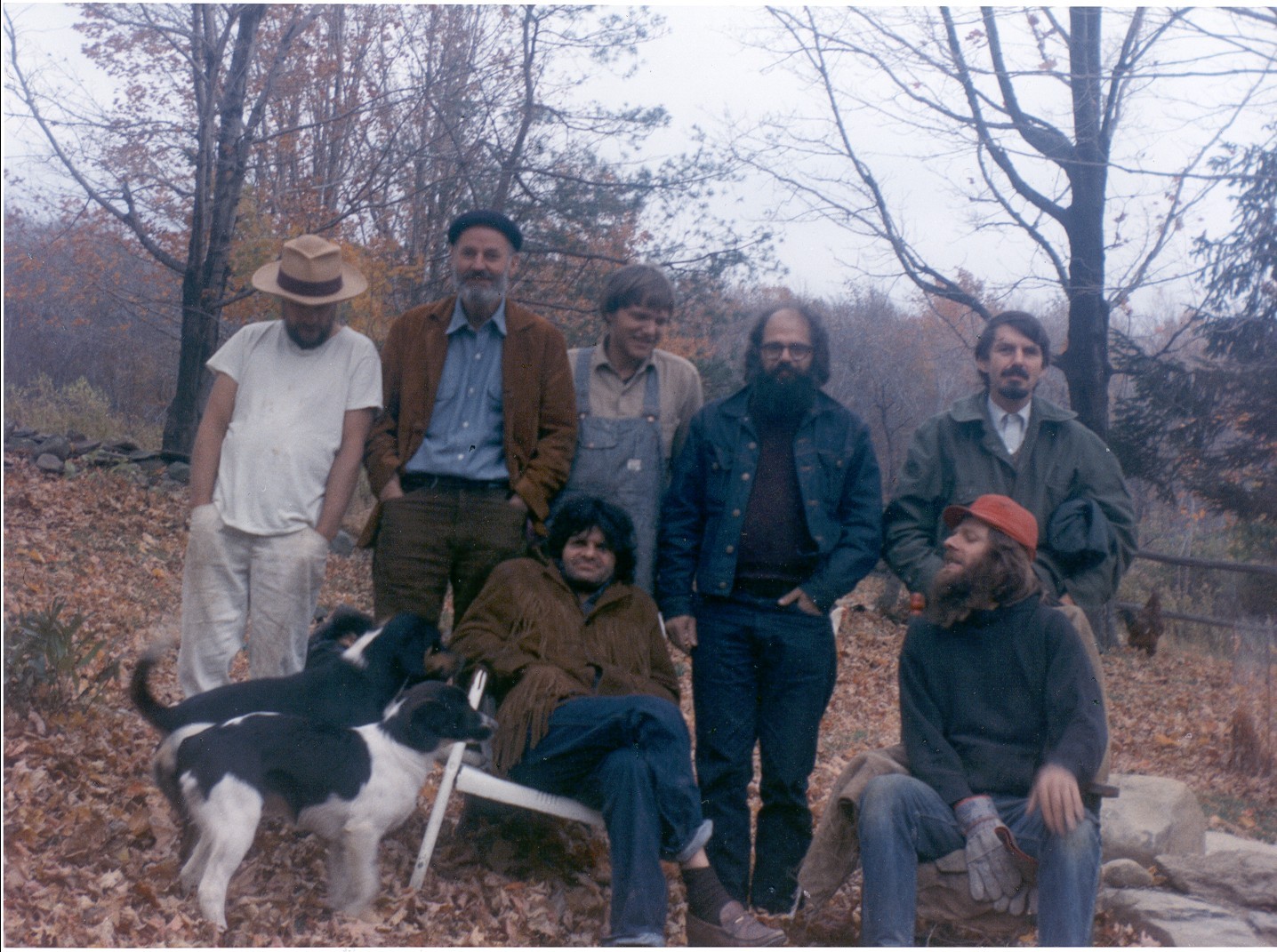 |
| Thanksgiving, 1969: From left, standing: Julius Orlovsky, Lawrence Ferlinghetti, Gordon Ball, Allen Ginsberg, Robert Creeley. Front, seated: Gregory Corso, Peter Orlovsky |
KIRPAL
GORDON: But as Gregory Corso puts it during a conversation with Bob Creeley and
Lawrence Ferlinghetti and the East Hill Beats about Kerouac’s death, “We’ve got
to have both sides of the story, Jack’s is one” (page 224). That faith and
sense of unity the Beats felt toward one another since their Columbia days
appeared to be over. Ball also makes clear that AG and company were still
reeling from JK’s recent and final published essay “After Me, the Deluge” in
the 26 October 1969 Los Angeles Times, five days after he died. The bard
from Lowell (and a lover of St. Theresa) delivered some hard and bitter words
for his old running buddies. The New York Post was waiting for Allen’s
comment on the essay. As Creeley told Ball, “Allen felt it was a no-win
situation.” Around the time of that essay, Kerouac was phoning Allen to inform
him of the “Great Jewish Conspiracy.” Do you see what I mean?
Take
it all the way back to his novel Big Sur, published in 1962. I think
it’s sadly obvious that the master of spontaneous bop prosody was suffering
from acute and severe alcoholism. It’s a tough way to go out, especially for a
lover of freedom and a seeker of Beatitude like Kerouac. At some point, the
booze takes over; the booze does the talking, the planning, the denying and the
hustling. The spirits of alcohol broke him down, made friends look like
enemies, reinforced worst tendencies. He left his life of travel and pilgrimage
and returned to the misogyny and MAGA-like politics of his folks and the old
hometown. Unlike his Tokay days of old, he now had money, but he was isolated
and living with his conservative mother and wife. He seemed quite disconnected
from the rucksack revolution, the New American Poetics tradition, the hitch-hiking
of highways and the repudiation of Joe McCarthy’s abduction of democracy: the restless,
wild, roman candle-bursting version of America he had helped inspire. Perhaps his
powers of observation and his love of his friends––his real gift and his real
subjects––were gone. Diving into the bottle did not
bring back the gift or his friends! Let’s take it back to 1957 with his
“overnight success” with On the Road. He was called King of the Beats
and interviewed as if he were the spokesperson of a movement. That had to be
disconcerting. To my appreciation Kerouac’s real contribution to American
letters is right up there with Ralph Ellison’s Invisible Man. Both
novelists are under the spell of Charlie Parker, re-vitalizing language through
the musical discoveries of the be-bop revolution. Heady stuff! I think his real
compatriot in music is John Coltrane. Jack and John were hard working, spiritually
driven seekers who translated their baptism into Yardbird’s flow and produced full
confessional genre-defying upliftment and Wholly Communion for an audience
bigger than just Beat and bop lovers. They celebrated their exodus from square
America and their New Jerusalem offered us a perpetual rebirth of wonder. Future
generations on the road to freedom will yet benefit. When I consider Kerouac’s oeuvre,
I also think of Nelson Algren’s work as well: they give voice to elements of
American life misrepresented and misunderstood in the mainstream.
I
agree that Kerouac’s death birthed a profound moment in the Beat Generation. Call
him a glutton for (or addict of) celebrity, but Ginsberg just kept staying pertinent
throughout the rest of his life. To me, Allen’s counterpart in music is Miles
Davis who was born the same year as AG and Trane (1926; Kerouac, 1922). Like
Miles, AG stayed on the scene, re-invented himself, defied his own limitations,
expanded the power of art to change people’s lives, especially the young at
heart. Yes, he spoke to the next generations through music. Like Miles’ Bitches
Brew which had just hit, Allen and his harmonium was the next chapter of
the oral tradition he had been renewing since the Six Gallery reading (1955). Ginsberg
would remain loyal and carry the flock of down-and-outers on his back for a
long time yet, but regarding your remark about Allen being in over his head as
not necessarily a bad thing, he loved his mother. She was crazy and
institutionalized, so why shouldn’t he seek to make the world safe for
marginality for his crazy and institutionalized friends?
Regarding
your question, does the book do justice to the women of the farm, I would say
there is not enough evidence to hazard a guess. It’s kind of out of focus. I don’t
get the feeling that the community, at least the men, thought too much about
gender roles or women’s rights particularly, though these issues were big time
and mainstream back then. As for Ball, he was only a few years out of college
and new to the game of love. Yes, it’s great reading of his open-mindedness,
but (like all of us) he had trouble de-coding the messages of his partners,
which led to more entanglements than enlightenments. Ball is refreshingly
matter-of-fact regarding sex, as you point out, and a lot like Allen on that
subject. But I find that reading about other people’s sex lives can get tiring.
Where
does Gordon Ball excel? I agree with Ann Charters, who calls him a “Beat
Boswell,” and Bill Morgan, who calls him “a masterful story teller [who] could
turn a depressing tale of poets at rock bottom into a triumph of the human spirit.”
That’s the real shot.
 |
| Jim Cohn |
JIM COHN: East Hill Farm appears
to me to be a work of outstanding personal research and scholarship. Charters’
remark suggests as much; the book is a matter of detective work, investigative
nonfiction piecing together of various literary and historical sources. Ball
had his own journals, as he reveals throughout the text. He seems to have
compared his timelines with Allen’s notes, more likely than not, through research-visits
to Stanford where the one thousand linear feet of Ginsberg papers are housed
for posterity. It’s a great trick of sorts how he lays passages from his
journals with Allen’s again and again. One informs and illuminates the other. Is
he reading Allen’s journals in the moments from the past he’s describing? Is he
comparing his own journals to those of Allen’s after the passing of decades
from within the confines of that reading room at Stanford with its myriad
closed-circuit cameras recording visiting scholars every move?
I think the book was written to defy
that otherwise “depressing tale of poets at rock bottom” you mention. I
remember finally, years later, seeing the awful Alison Ellwood and Alex Gibney
2011 film Magic Trip, made from footage taken by Ken Kesey and
the Merry Pranksters on their 1964 tour of America on a bus named Furthur and
thinking to myself, “This looks like a hellava lot less than Tom Wolfe made it
out to be.” There are things about rural America that urban America fears. Not
the least among those fears is the dread of isolation; feeling cut off from the
mass imagination of materialism and winning; the fondness for things to
populate America’s servitude to capitalism. I would argue that Kerouac’s art
leaned into the past for its sustenance. Allen’s leaned into the future. Gordon
Ball, as the writing itself suggests, exhibits the power of the present.
There’s a certain magic in maintaining
one’s presence and farm life is an ideal way to formalize that. In an idealized
American literary sense, there’s Brook Farm and the Transcendentalists. But Hawthorne
didn’t stay there all that long and he was a founder. Poets and writers do not
make for the best farm laborers; not in America, generally speaking. Hawthorne
thought better of his Customs House work after feeling his soul buried under
cow shit. Emerson never joined the community though he was invited several
times. Thoreau seemed to feel his individualism would be thwarted living there.
Solitude was far easier for him to making a writer’s life from than working a
community farm.
But Gordon had the wherewithal at this period
in his life, regardless of the sense that he had of not knowing if this was the
right path for him, to make something out of the materials and beings before
him. It seems to me that Ball saw a form of activism by simply keeping record
of the Great and Small changes within and around him. In collecting enough
data, he exhibited a trust that it would lead to its own trends, much like the study
of the weather. You take the temperature of a place daily, note the amount of
precipitation and wind speed, the humidity in the air, barometric pressure, and
pretty soon you’re mapping out climate change, and hopefully, a way through our
man-made changes to our planet.
There was one detail that I thought Ball
would discuss that he never did and I’m curious what your take on it was. I’m
talking about the coal-burning stove in the kitchen. Here’s Allen
setting up East Hill Farm and there’s Gordon and friends tilling the fields,
growing crops, moving in the direction of organic farming methods, and never
does he talk about the coal burning at the center of their existence.
Today, we accept that coal, as we have used it as a resource, is a major source
of pollution. Was he trying to make a point about the limitations of our
idealism? I don’t really know.
KIRPAL GORDON: You bring up interesting
issues about Ball’s method of scholarship, data collection and access to
Ginsberg’s archives at Stanford. There is something thorough and thoughtful and
detective-like going on in East Hill Farm, just like Ball’s earlier work
as editor of Allen Verbatim: Lectures on Poetry, Politics and Consciousness
(1974).
As for coal, as for gender roles: I
don’t think it was on the minds of the East Hill community much. From my own
experience of living upstate (mid-Hudson Valley), I would say that avoiding
freezing to death often takes on the phrase: by any means necessary. As you
note early on, Allen and krewe made it up as they went along. So many of the
“improvements” of the farm seem born of the moment, not exactly the result of
planning. On the other hand, spontaneity served them well. They kept finding
people who knew what they didn’t know, whether it was about water or
roads or cars or heaters or ditches or musical chords. The memoir pays tribute
to the kindness of these country folks who come to the aid of the city folks
often and in good spirits. Indeed, it is the opposite of the rural/urban split
dividing the nation at that time.
As for idealism and its limitations, I
can say for sure that Ball exposed the limits of my own idealism throughout
his memoir! I wanted to dive into the tale on any number of occasions and
confront Peter Orlovsky, Herbert Hunke, Ray Bremser and Corso on their intent
(conscious or unconscious) to sabotage the community. Total props to Ball for
his patience and equipoise!
The strength of Ball’s position––and the strength of the story––is his trust and insight into what Allen was doing
globally/locally. Each page brings you deeper into his apprenticeship not with
Allen but with the behavior AG is modeling as a poet, artist, citizen,
communard. As you say, Ginsberg’s having fun with the locals, but he’s also marching
against the war, raising money for incarcerated comrades, researching the CIA’s
drug involvement in Southeast Asia, testifying at trials, speaking truth to
Nixon’s war-mad power play, reading and writing poetry from this insider’s
point of view. His sacks of mail alone are keeping the town’s post office from
closing! As you noted on Kerouac, he knew the loneliness of the long-distance
runner but couldn’t enter the cultural revolution he had helped instigate. Ball
demonstrates how Ginsberg skillfully joined with a number of progressive forces
to stop the war and widen our lens to view a rainbow coalition, the latest
iteration of Whitman’s Democratic Vista. To whip that old contrarian phrase, it
was the counter-culture’s finest hour. Bodies were dropping. In 1970 law
enforcement killed white and black students at Kent State and Jackson
State. It was no time to be aloof or ironic. Just like now. The country is so
divided down the middle that no one seems to be listening to the other side
much. I think that’s the value of Ball’s memoir; it’s a corrective not just to
the Beats but to a form of openness, a way of being, that the nation is in
danger of losing.
All Ginsberg-related photos copyright Gordon Ball. Unauthorized copying in any form is a violation of applicable laws.
 |
| Gordon Ball |


