Wednesday, August 29, 2012

Poetry Activism in the Wavy Gravy Lineage: An Interview with Thom the World Poet


KIRPAL GORDON: In the last Taking Giant Steps interview Terri Carrion and Michael Rothenberg articulated a vision of poetry as activist-centric rather than career-centric. You’ve been a model for the kind of activism they celebrate for as long as I’ve been coming to Austin. You’re out every night of the week mcing or organizing readings, open mics and music-word collaborations, yes?

THOM THE WORLD POET: We know the alternatives-nothingness/ passive consumerism/product based ecologies/alienation from creative processing
Activist hippy punk ethos sez YOU ARE RESPONSIBLE 4 yr own expression
This has nothing to do with market mechanisms-more community formation awareness
EVERYONE IS AN ARTIST (if they so desire/and in their own manner and style/in their own time and mind.


KIRPAL GORDON: You’re powerfully representing the Wavy Gravy lineage of poesy!

THOM THE WORLD POET: he began as a poet
merged /morphed into public peaceful activism-
HOG FARM, excellent art, "breakfast in bed for 400,000"
he was sick of getting beaten up at peace demonstrations'
so he became and remains a clown
nobody fears a clown
my role model = he gives via benefits to aid clear vision in third world countries
he has many musician friends who "get" him and support his work/play
his poetry has become actions and lifestyle
He came to Austin for the launch of his film
and was at our Million Musicians March for peace
I will never forget his mantra
GIMME AN "F"
F!
GIMME A U-
U!
(what do you expect next from a smiling dervish?-
GIMME A "N"=
FUN!

KIRPAL GORDON: How did your art get started?

 photo by Paul Hoelen

THOM THE WORLD POET: Started improvising to music @ AQUARIAN FESTIVAL Nimbin 1973
Formed POOR TOM'S POETRY BAND which had strict rules
1. Anyone who turned up was in the band
2. Never repeat. Never repeat
3. Ignore the first two rules

Folk reminded me that no one listens anymore. They suggested i publish my improvisation
So began STREET POETRY -thousands of poetry sheets daily on the street of Melbourne
This spread to Adelaide, Sydney, Armidale, Geelong -and WOMEN'S (street) POETRY began with Alicia Stammers

Folk reminded me that no one reads leaflets anymore-that i should publish my improvisations in books
200 books later (www.worldpoetry.org)-and no one bought any
So i return to improvising with musicians every moment of my life


KIRPAL GORDON: What were the circumstances of your arrival in Texas? How do you explain the explosion of poetry there and the Austin International Poetry Festival---how long has this been going on?  


THOM THE WORLD POET: I was touring America with an eco-feminist band MOTHER GONG in 1991
We supported BIG BROTHER &THE HOLDING COMPANY, BOB DYLAN etc
I met my beloved and moved to Babylon (Austin, Texas)
Met poets at CHICAGO HOUSE. With 3 others, started AUSTIN INTERNATIONAL POETRY FESTIVAL
This is its 20th year. Many new venues arose from featuring poets@open mikes
The litany of ancestral venue names still enchants-ELECTRIC LOUNGE, FORRAYS, RUTA MAYA, CAFE MUNDI, etc
Most nights now have one or more open mikes for folk to just turn up and they are on.
The price is still participation. Every night different.
Some have survived several owners (like CAFE CAFFEINE Wednesdays)-now THRICE CAFE
The core of all is volunteer. People host when and where they will-features are picked for qualities of content and performance
and a positive link to all poetry groups defines Austin 2012


KIRPAL GORDON: You’ve managed to marry a spoken word line of depth and insight and knowledge of world lit with a progressive agenda at the local and world level. Are these two things one to you, lit and politics? I also like how willing you are to be improvisational when working with jazz musicians in Austin.


THOM THE WORLD POET: Poetry is politics. Freedom of speech and assembly. Censorship is everywhere. We prefer uncensored all age readings but also cater for guided (age appropriate) content readings.

We vote with our time, effort, focus, attention and concentration. Our allies do things their own way. We are all different. Diversity is.

WORDJAZZ is a current Thursday night gathering of professional jazz players and poets @Kenny Dorham's Backyard (next to the VICTORY GRILL)

This eclectic gathering of divergent skills makes for compelling listening to a minimal audience. EVERY NIGHT IS DIFFERENT.


KIRPAL GORDON: You seem to be constantly inventing, and every time I’ve seen you at a microphone or on a bandstand, you’re giving away poems, books and CDs.


THOM THE WORLD POET: I am learning to improvise in every moment-in my own life, adaptation is all. I respect and respond to kindness and do not believe anyone or anything. Deeds are words to me

I look for the living and work/play with consenting sentients. This can happen anywhere. I used to tour England and Australia until funding cuts

I flow where support and encouragement grow.


KIRPAL GORDON: What counsel would you give a young poet?


THOM THE WORLD POET: To the young and the new-LOOK @WHAT OTHERS DO-then do it differently

Life is short and the dead are many. Look for life/Light and kindness. BE THAT!


KIRPAL GORDON: How can readers of Giant Steps stay in closer contact with all of what you are doing?


THOM THE WORLD POET: I am contactable on FACEBOOK, email (worldpoet@rocketmail.com), and (for paid shows)-by phone 512 4167435

The rest is your stories… do what your dreams allow-then more!

 
KIRPAL GORDON: Click these for scenes of Thom & his krewes reciting in Austin settings---


Ruta Maya - video @ thom woodruff / dana mcbride / william sickwitt


Sunday, August 26, 2012

Poets for Change: An Interview with Terri Carrion & Michael Rothenberg

 
KIRPAL GORDON: First off, let me say congratulations to the two of you. You are celebrating your second year of doing 100Thousand Poets for Change. You’ve organized, sponsored, promoted and created events all over the globe traveling widely and meeting all kinds of activists, writers and musicians. What kind of impact has this project had on your own creativity? I know you both work multi-genres: poetry, fiction, nonfiction, songs, collaborations with other writers, editing, translating and photography. What did I leave out? I’ve also seen you both on tour and know that you do many readings and collaborations with musicians. Did you both start out this way, open to all forms of writing, or did this evolve over time or in response to the nutty way the lit game is set up in the USA?


TERRI CARRION: My main interest was always telling stories and it didn’t really matter what form that took.  I had trouble trying to put my writing into categories from the start. I found it all too constraining and boring really. I guess I always felt that making art or expressing your reality creatively, whether through writing poetry or taking photographs or singing a song or doing a dance, was pretty much the same to me. I find it hard when artists separate themselves into these “disciplines” for the sake of specialization and career. I think it creates a stagnant and predictable arts culture if people aren’t mixing it up and learning from each other more often.  I remember a fellow MFA student who was working on a novel saying to me that he didn’t like poetry at all. I couldn’t believe that as a writer, he felt this way. It was really disappointing to me. And I thought, Wow, he shouldn’t even be a writer if this is how he feels!  As far as 100TPC, there is a lot more collaboration and interaction going on between the artists involved. Overall, I think they get it a lot more in other countries that musicians and poets and painters, etc. are supposed to work together. They understand that it’s natural to do this. It definitely makes me feel better to see it happen.  And hopefully, being able to interact with artists like this through 100TPC will help artists in this country want to expand their creative horizons. That is part of the idea, anyway, to create a more interconnected and diverse global arts community.


MIKE ROTHENBERG: From the beginning I understood multi-genre creativity was always in the program. My early inspirations, the Beat poets and the Romantic poets, were diverse, wrote poetry, plays, fiction, political tracts, essays, memoir, worked with musicians, they showed me that the field was entirely open and flexible. It never occurred to me that I couldn’t mix it up. And that also meant mixing styles within the same work. There was a day when you could go into the doctor’s office and tell him you had a sore throat and he would take care of you and not send you to a specialist. Maybe that’s a clumsy analogy.  And since 100TPC, my idea of “world poetry” is much more viable. It seems contemporary “world poetry” has been the venue of university professors who can meet with other university professors from other countries while the rest of us are completely in the dark about international and global tendencies. Not everyone can afford to go to an international poetry festival on their own dime. Finally, because of 100TPC, we have the opportunity as “unaffiliated” poets to meet with great poets from all around the world. I feel my perspective as a writer is more “global.”


KIRPAL GORDON: Hey, when I was in graduate school in the Seventies, forms of (post) modernism still ruled. I’m talking about the writer as the cloistered hero, working away in her private woodshed, producing work that had to pass muster with mentors-professors, agents, editors and publishers before it would see print on page or performance on stage. That’s a crazy way of doing things, and both of you seem to have produced an alternative model that accentuates the individual voice but without the scaffolding and hierarchy that has dominated and limited the American lit scene. Is this by design or by accident?


TERRI CARRION: I rejected pretty much all of it when I was in my MFA program. I rejected the notion of first book contests, and all that ponzi scheme nonsense. I refused to follow the rules of plot in fiction classes, so I ended up writing memoir, and then that got way too structured and predictable as well, so I ended up writing poetry, but in the end, I was writing prose poems, which were really stories, which were really memoirs, which were really well, whatever they were/are … so there you go. I was having a really hard time my last semester, and that is actually when I met Michael, who helped me a lot by exposing me to writers they would never teach in a typical MFA program. It helped me realize why I was uncomfortable with the way the MFA program was designed, that it wasn’t there to nurture creativity or give artists a place to come together, which is what I naively thought at first. It was there to produce aspiring best selling novelists and poet laureates and adjunct instructors. So, I just did what I had to do and moved on. That is really it.


MIKE ROTHENBERG: It is by design and accident. I have never been vigorously competitive though some might argue with that because I am “motivated” and goal oriented. I have never been comfortable battling for some kind of top of the heap position. I got into poetry because I didn’t want to be the richest lawyer or the star of the football team. I didn’t have the build or disposition for the latter. So when confronted with “agents, editors and publishers” I ran the other way. I took a few workshops and went to a few writer’s conferences and it made me want to quit writing rather than write more. But then I have this mode where I would rather do more work than be defeated by systems that frustrate me. So I work harder to make my work clear. If you can’t get permission to go through the door, you create your own door.


KIRPAL GORDON: You also both edit Big Bridge, a monster e-magazine that I have been following since 1997. At first it focused on the many “schools” or tribes that comprise the New American Poetics as put forth by Don Allen in his anthology of the same name in 1960 which was great because they have been so under-represented. More recent issues have focused on what I would call an international version of NAP and beyond. Is this the result of 100T Poets for Change, reading more in translation or just the globalization of the literary village?

ow does HH
TERRI CARRION: Yes, of course, 100TPC really connected us with some wonderful writers and artists around the world that we never would have made contact with in any other way. It is important to offer all these “bridges” to help connect us and expand the scope of what a publication can do. Most publications are very inbred and redundant in my opinion.


MIKE ROTHENBERG: Globalization of the literary village. Big Bridge has always been a “big tent” and when it became clear that there were more people who wanted to play we just made a bigger tent. It is exciting and inspiring. I am learning a lot about poetry, literature, and art from Big Bridge. And more right now because of 100TPC. Without meaning to take a wild shot at the USA, I hope that 100TPC is helping move us all from a certain kind of provincialism and literary jingoism that seems to exist in these parts. And I want to say that the NAP moniker is a bit narrow too. The schools of poetry represented by that in no way represent the entire width and depth of global literary tendencies. NAP is a convenient framework but also a crutch. There were many great poets who were excluded from that landmark anthology. A great introduction that surpassed anything available through a Norton’s Anthology (to this day) but still not inclusive or representative enough to describe what we are hoping to achieve through Big Bridge.


KIRPAL GORDON: You both have a Miami connection. Is that how you met? You now live in northern California in the redwood forest? What’s that ride been like?


TERRI CARRION: Yes, we met in Miami.  I wanted to come back to the West coast, (I grew up in LA) so we made that plan. It is an amazing place to live, among the Redwoods, but it is a bit isolated and I do miss being able to walk down the street for a real Cuban sandwich or a late night slice of New York style pizza! I think that is what I miss the most about the “big” city, the cultural diversity on all levels, and how people do tend to mix it up more because they have no choice, they have to live together. I really took that for granted before I moved to Northern California.

 
MIKE ROTHENBERG: I was born in Miami Beach and came out to Pacifica, California, in 1975 where Nancy Davis (my ex) and brother together opened up Shelldance, a tropical orchid and bromeliad nursery.  Eventually, Nancy and Bruce and I went our separate ways, priorities change, though I am still marginally involved with Shelldance. In 2002 I left California to go back to Miami to take care of my mom when she was dying. I met Terri there. She was a transplant from Los Angeles living with her mom and working on her MFA at FIU when I met her.  So we hooked up there. After a couple of years living together in Miami we moved out to California and have been sequestered away in the redwoods since then. I like the forest. We both do. But after almost 7 years in the shadow of the immovable giants we are looking to make a run for it. I really need a shave. And a slice of pizza. So we are looking to move into a more urban setting. We need a little more city life to keep us from succumbing to cabin fever.


KIRPAL GORDON: Terri, you’re working with Occupied Press/Prensa Ocupada. What’s happening with that? You’re studying accordion? Mike, you’ve recently been editing poetry volumes for Penguin. Is that still happening? Are you working with Elya Finn and other singers?
To both of you: what’s your next literary project, when will it be out and how we find out more?

 
TERRI CARRION: I just recently joined the editorial collective of a new publication, OP/PO. The goal is to produce a completely bilingual, alternative to the mainstream, news source for the North Bay area. Sonoma County has become quite a desired retirement area for some of the powerful banksters (see banker-gangsters) and CEO’s that caused the 2008 financial crisis. We want to educate and inform both the Latino and white communities here which seem to live in different worlds completely about what is going on in their neighborhood. The idea is to bridge the cultural gap by presenting local stories from and for both communities, in both languages. I am mainly working as translator and I am also putting together the Culture section, which will include poetry, art, etc. The online edition should be out by the end of August. The print will have to wait until we get some funding, but we will definitely be doing a print edition that we can put in people’s hands. Not everyone is on the internet, believe it or not!


MIKE ROTHENBERG: I have been away from poetry book editing for a while. The last big project was the Collected Poems of Philip Whalen (Wesleyan University Press) in 2007. I am hoping to work with Joanne Kyger on a new selected poems but we haven’t gotten final confirmation from the publisher yet. But I am always excited to work with Joanne. She is one of my most important mentors and a dear friend. She is always an inspiration. It’s been a long time since I have written a song but I do look forward to continue giving poetry readings with musicians. Reading with musicians is bliss.


KIRPAL GORDON: If a writer, musician or performer happened to be interested in 100T for Change, what should she do? If interested in Big Bridge, where would she go? If interested in both of your lists of titles and where to buy them, where would she shop?


TERRI CARRION & MIKE ROTHENBERG: If someone wants to organize an event for 100TPC all they have to do is write us at walterblue@bigbridge.org or go to the signup page at the 100tpc website www.100tpc.org. Once we hear from participants we will create an event page for them at the site. Each event page is archived by Stanford University, so we encourage and assist organizers to post poems, event details, times, locations, event photos, videos, etc. to their event page so that together we can tell our collective story for Stanford archives. That’s it!

For Big Bridge, go to www.BigBridge.org and help yourself to all that is there to read. It’s free. If you want to submit work please check the guidelines in the SUBMIT menu.

If you want to buy a book, just write to me. Some items are on Amazon. But you can write to me too at Michael Rothenberg, Box 870, Guerneville, CA 95446.

Friday, July 27, 2012

Talking with A Very Funny Fellow: An Interview with Donald Lev


KIRPAL GORDON: Donald, first let me say congratulations on the recent publication of your new collection, A Very Funny Fellow, your fourteenth book of poems, as well as your appointment as the Northeast Poetry Center’s Distinguished Visiting Poet for the summer of 2012. What will you be doing, when and where? Are you on a book tour now? When did it come out? What’s going on?


DONALD LEV: The book came out in February, and since it’s a pretty substantial collection put out by a good publisher in my 76th year, I thought I’d give it a shot. So I set up a sort of mini-book-tour. Not being much of a traveler the tour took me only as far north as Albany and will end up on August 13th at its southernmost limit, the Princeton Public Library. I’ve read as far west as, I guess, Woodstock.


KIRPAL GORDON: Raymond Hammond at New York Quarterly Books did a fine job putting together 92 of your short poems which are wry, quirky narratives on the foibles of being human. The only thing that bugged me was the story behind its title, A Very Funny Fellow, but I may have missed the joke. When Marguerite Harris called you around 1971 to tell you, “You’re a very funny fellow, but you are no poet,” what was she thinking? Is she hung up on formalism all these years after William Carlos Williams’ variable foot? The achievement of the book---and of your style---is the exact sound of your mind and mouth in print; the poetry’s in the event, not how much poetic language you can scaffold on to it. Like:


A Man and His Clone

I am on a westbound train, sitting at a white tableclothed table playing casino with my cloned son Robert.
Robert’s not too bright, but he’s goodhearted, or wants to be.
He is beating me more often than not at this game I’ve taught him, which my father (of whom, unfortunately, I’m no clone) taught me.
I think we are in Oklahoma, or maybe New Mexico---one of those gorgeous western states speeding past as we play our cards.
I would ask Robert where we are, only I know he wouldn’t know if I don’t.
We are on our way to California, where a man and his clone may feel reasonably secure. I once had a premonition I would die there; that was 1965. It hardly matters now.


Why can’t she call you funny AND a poet?


DONALD LEV: Well, Maggie was this very opinionated old battleaxe (I don’t think they make those anymore) at the time and was certain she knew (She wasn’t the only one. I wish she was.) what a poem really was. She was kind of old fashioned, but, in a way, genuinely majestic. I liked her, actually. I didn’t mind what she said (I  had a certain confidence in my work), I just thought it had a kind of stylishness and kept it in mind all these years.


KIRPAL GORDON: What about economy of language? What better gift to give the reader and what better image painted than when told with not one extra syllable. Like your elegy to Ira Cohen:


The Return


All sounds stopped. The instruments muted.
If birds there were, they were unheard.
And every soul sat cross-legged on the ground
intoning eternal ohm to energize
ailing poet, home at last from his travels,
head bowed under his large hat
like sleeping mexican under sombrero
on my mother’s cookie jar.

It’s all there, Donald. What do you say to that?


DONALD LEV: The poem was written some years before Ira Cohen died. I was present at a reading he gave at the Colony in Woodstock and the poem is pretty much reportage. I try to be succinct whatever I write. Once a poem has completed its message I try to stop. Of course there are many kinds of messages. Mine just happen usually to be brief. The cookie jar really existed.


KIRPAL GORDON: Lawrence Bush nailed it when he called you “America’s great taxi driver, telling stories so rich, observant and personal that you forget all about the running meter and the appointments you need to keep. This collection has a huge, comfy back seat.” You drove a cab back in the day, what, for twenty years?


DONALD LEV: I’m the last victim of the great newspaper strike of 1962-63. We were out so long the strike funds ran out, then after more waiting I got unemployment. There was no work around, so when some friends were going out to California I went with them. I couldn’t find work there either and Gov. Rockefeller decided I no longer deserved unemployment. But I was in San Francisco, and when the strike ended I wasn’t quite ready to go back. When I did, the Times informed me my job no longer existed. So I got a hack license. Other glamour jobs I did were dish washing and foot messengering. And some time in the 80’s after I moved to Brooklyn I threw commercial plates on my hatchback and became a courier. And wound up distributing publications I told myself were of “cultural interest” beginning with the New York Poetry Calendar and ending with The Aquarian. A good swath of the 70’s I spent messengering for the display ad dept. of the Village Voice, where I was also publishing a lot of poetry and prose poetry at pretty good rates.


KIRPAL GORDON: You also worked in the wire rooms of the Daily News and the New York Times and you’re in one of my all-time favorite-films-on-a-desert-island list, “Putney Swope,” directed by Robert Downey, Sr. You play the part of the poet in a film that is a work of poetry, I mean the ad agency head dies on the spot and a token black art director gets voted CEO---it’s a total hoot and send-up of Madison Avenue’s invasion of our skulls, a celebration of words and a retaliation against the jingles that sell us soap: the Beat Generation Meets the Black Arts Movement, and the script is hilarious. And those two repeating phrases---“How many syllables, Mario?” and “Putney says the Boorman Sixth Girl has got to have soul!”---I still hear people say them on the street.  What were these experiences like?


DONALD LEV: I used to live in Forest Hills, Queens, where Bob Downey also lived. He used a number of us from the neighborhood in some of his films. And sometimes I’d be driving crews to different locations. Robert Downey Jr. and I both made our film debuts in his father’s film “Chafed Elbows,” he in his mother Elsie’s arms (Elsie was a wonderful actress and comedienne in her own right) and I getting thrown off a roof in Burns Street, Forest Hills. How I and my poem “HYN” got into “Putney Swope” was thus. I was giving my first featured reading in a place called Olivia’s Atelier East, which was attached to the old Broadway Central Hotel, at the same time Bob and some of my musician friends were performing some music that was supposed to go into “Putney Swope” nearby at the Bitter End. Anyway he came over and caught my reading and said he wanted to use my poem “HYN” in the film. Which happened. I got paid $75. $50 for reciting the poem and $25 for milling around in the picket scene. I was told it was “union scale.” My apex in the film industry. And to this day, I guess HYN is my most widely distributed poem. And aside from all this it is a great film, isn’t it? I think now some of Downey’s humor might have rubbed off into my own work.


Home of Home Planet News
Home Planet News The Independent Literary Review

KIRPAL GORDON: Yikes, talking with you takes me back, lad, to the first time I saw Home Planet News in the early 80s. It was a big hit with my creative writing students, both in college and in prison. I think the young as well as the incarcerated appreciate its candor and lack of pretension. I enjoy the tabloid newspaper look, the no-frills approach, but more, the poems and reviews move me. Sometimes it’s hard to find a magazine that makes me want to read all of the contents, but HPN gets my vote. So what’s it been like doing this project since 1969? You also ran a bookshop called the Home Planet News?


DONALD LEV: The Home Planet Book Shop was in 1970 or ’71. I had already launched my first mag, HYN Poetry Quarterly & New York Muse, A Yellow Journal of the Arts, which ended its life titled HYN Anthology with its 4th issue published in 1975. It was just a storefront I paid too much rent for on  E. 9th & Ave. C that I moved to because my girlfriend of the time was bored on University Place (we lived in the Albert Hotel) and wanted to live somewhere more exciting. So I threw some books in the window, kept a big urn of half Maxwell House, half Bustelo going, and had poetry readings practically every night for company. Anyway I was sharing a loft at 334 Bowery with a photographer named Paul Henning when HYN died, and I began work as editor on a newsprint literary magazine called Poets, published by a mad genius named Mike Devlin, who had an office on Union Square in which were half the files of a publication called Poets & Poetry he published formerly (the other half of the files became Dodeca and then Contact Two). I got Enid, who I knew from an organization called The New York Poets’ Cooperative, to come in as an associate editor. She and I got together at editorial meetings, moved in together, and when Mike disappeared with the boards of Poets #6 under his arm, Enid and I got hold of an electronic typewriter and launched Home Planet News. What’s it like? Well, it doesn’t get easier.


KIRPAL GORDON: I remember the first time I heard you and your life partner, Enid Dame, give a reading together in Staten Island in 1983. What has stayed with me was the rapport the two of you built with the audience. You both work different sides of the street as poets but the compliment of talents proved to me that a skillful line-up is greater than the sum of its parts. Now that she has passed, I’ve seen you read a few times on your own, and you’re still building rapport with the audience. Talk about the art of reading your work in front of others.


DONALD LEV: I broke the public reading ice in 1967 (long after I started writing and publishing my poetry) on Gansevoort Street Pier in the Village where they had open readings Sunday afternoons started by poet/actor Ed Blair sometime in the early 60’s. A lot of people weren’t there for the poetry and it was noisy, and there was no mic! So you had to learn to project. Which I did. I guess there’s just something about projection that’s enjoyable, because I’ve been projecting ever since and enjoying it.


KIRPAL GORDON: Tell us more about the Madeline Sadin Award from New York Quarterly you were given as well the Lifetime Achievement Award you received from from the Catskill Reading Society/Outloudbooks.


DONALD LEV: The Madeline Sadin Award used to be awarded for the best poem in each issue of New York Quarterly. Mine was for a poem called “Wilderness” which appeared I think sometime in ’73 and was about God getting arrested. The Catskill Reading Society is Bob Richards and his family who live high on Red Mountain near the Ulster/Sullivan border. For many years they used to host the Outloud Literary Festival (which at first happened in their barn. They did some publishing too, including a book by Mikhail Horowitz and two or three by a wonderful Connecticut poet named Hugh Ogden, who met an untimely end in a freak accident. Bob published four of my collections including a Selected Poems in 2008. They gave me the award (I don’t know why) in 2003. Enid was still alive. Some of the last photos I have of her were taken at that event.


KIRPAL GORDON: How do Giant Steps Press blog readers stay in better touch with all that you do?


DONALD LEV: Subscribe to Home Planet News. $12 will get you 3 issues. Address is P.O. Box 455, High Falls, NY 12440. I’m stubbornly a print guy, but we have a website, homeplanetnews.org, which runs selections from each issue.


Donald Lev

Monday, July 9, 2012

Jester, Traveller, Composer, Bandleader, Sideman: An Interview with Arthur Kell


KIRPAL GORDON: Seeing you and your quartet (plus one) play last week at Cornelia Street Café, I was knocked out by the performance.  I had last seen your band three years ago, and as I thought about the two shows, I found these two quotes on your music: 
       “At no point during this amazing concert did the audience doubt that tremendous art was being performed here. Arthur Kell is an excellent composer, instrumentalist and band leader. Although his compositions sound gentle, they have exceptional bite. The quartet sounds like it is cast from one sound...Both the ballads and the quick, concise pieces are convincing with their ingenious complexity…in some magical way they are together, rhythmically and harmonically...true musical mastery, as is only rarely heard.”
      After their glorious appearance, the explosive Arthur Kell Quartet from New York has a new group of fans, many of which left the hall with glowing eyes. Bassist Kell is an impressive soloist, but above all a very expressive composer well-versed in music history…the amazing thing is that even if it gets complicated and sophisticated, the music overall is still accessible, and radiates serenity, even with quicker pieces.”
         The first quote, from Peter Bastian in Badische Neueste Nachrichten (Karlsruhe), feels so much like last week’s show, even with Mike Blake on tenor sax sitting in. It was deep magic.  The second quote, from M. Scheiner in Mittelbayerische Zeitung (Regensburg), aptly describes the impact of your performance at the Jazz Gallery in 2009, a radiant serenity.  Would you agree?  Both events were CD release parties, yes?


ARTHUR KELL: Yes, both concerts were cd releases: Jester most recently, and Victoria: Live in Germany in the ’09 show. For me, the music opened up a lot more on the more recent show – we reached that place where everything is musical and happens almost effortlessly and there isn’t much distance between intent and execution. But after many years of performances, I’ve also learned that what I’m experiencing at the time is not necessarily what is happening in the music or for another listener. Even if we play just two sets on a given night, Mark Ferber (the drummer on both gigs) and I will often have completely different takes on which one was stronger. Recording sessions can be even more telling. I love the recording of “Ijinna” on my second cd, Traveller. But it was one of the first tunes we did early in the day and the entire time we were doing it I kept thinking that it was lifeless and dirge-like. Not so! It was so in the zone. It’s just one of those things that you have to remember about life: what your mind is telling you at a given moment is just a point of view that even you may not agree with. All I can do is do my best and hope that the listener is getting something from it.


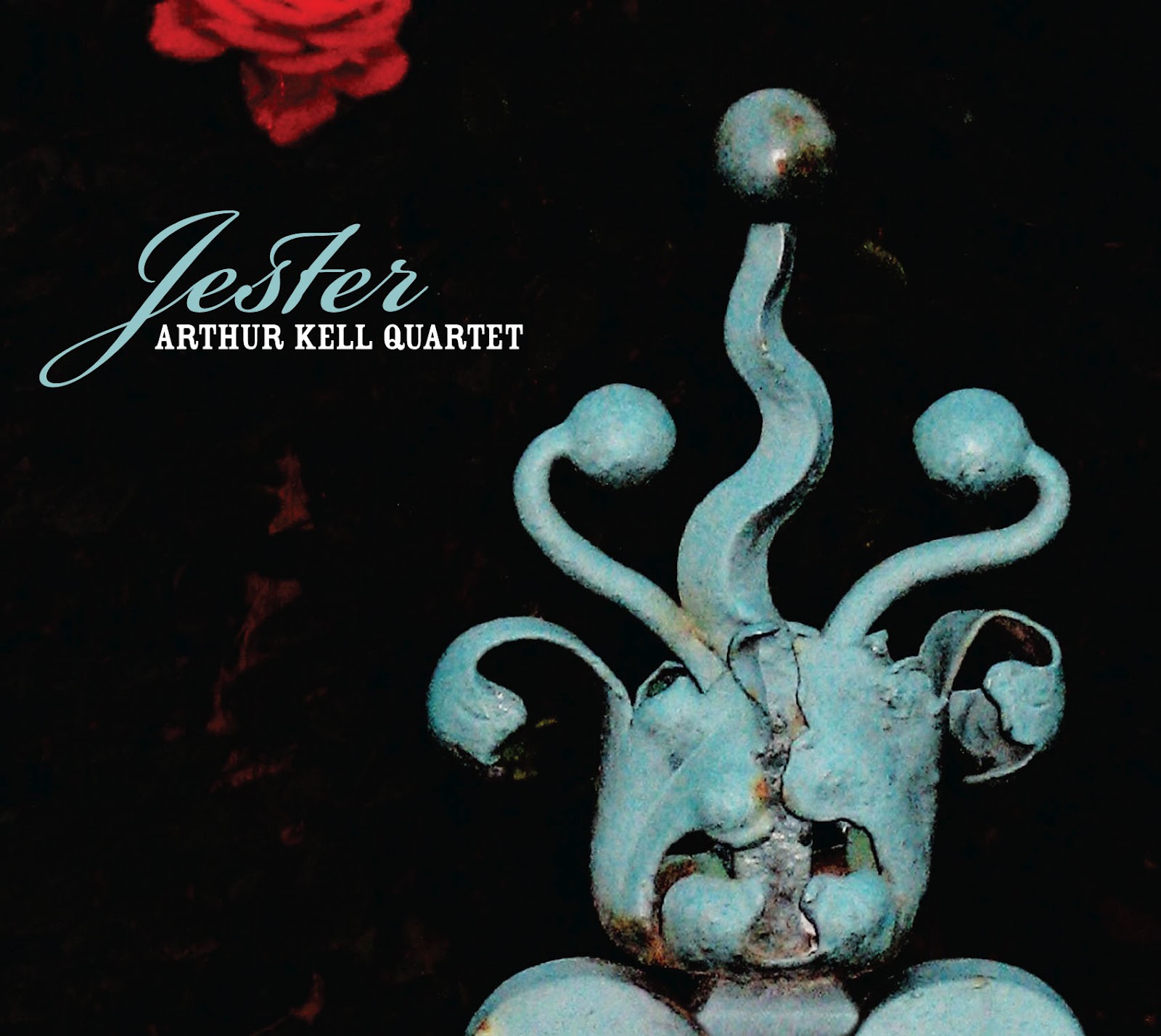
KIRPAL GORDON: I’m intrigued with the cover art of Jester as much as I am the cover art to Traveller. The image seems so emblematic of the music.


ARTHUR KELL: Itinerant musicians traveling from town to town for live performance, it’s an age-old role. But musicians and artists generally occupy a precarious and profoundly interesting spot in society. They can be adored, reviled, distrusted and considered indispensable in short order, depending on the audience. They can occupy both the highest and the lowest rungs of societal honor and respect. That’s why the jester image made so much sense to me. Although their age has passed historically, they represent the same remarkable and challenging role. If you dig past the common and shallow idea of jesters as silly people, you find out that jesters were present world-wide and in every conceivable role at the center of society: entertainer, closest friend of the ruler, powerful political advisor, idiot, comedian. In many situations, they represented free-speech in a constricted society. Because their social standing was the lowest, they could say what others could not say. They allowed a king and a court and a society to develop its ideas after listening to the “worthless fool.” They were like imagination in action, with all of the curiosity and questioning perspective of the person who is not part of normal society. It’s hard not to draw a line between artists of today and jesters of yesteryear. I feel like a quirky, weird, imaginative, curious jester. If my music captures that spirit then even better.
Also, there’s the fact that the jester on the cover is an iron jester. In many societies, blacksmiths are feared and shunned. An iron jester is a reflector of society created by an artist using a hell-like fire. To make it even more diabolical, he’s also kind of cute and very funny. He’s anything your fear or hope could create.


KIRPAL GORDON: You’re onto something about the jester’s gestures. Wavy Gravy (a/k/a High Romney) said he took more than a few beatings when he dressed as a fool back in the Merry Prankster era but never got roughed up playing the clown in America. Back to your music, between the release of Jester and Traveller is Victoria---Live in Germany, of which Matt Marshall wrote in Jazz Improv Magazine, “Everything that modern jazz should be: vibrant, challenging music from a band so tight within its group dynamic and so confident in its individualistic chops that every movement is a lively step forward. The recording retains all of the energy of a kick-ass live event and should receive serious album-of-the-year consideration.” All About Jazz said, “...exquisite solo moments, but the music’s lyrical bent and the quartet’s collective talent for nuance is what brings this disc home...the sense that these are stories never wanes...the results are very, very good." Something Else accused you of being “a no-nonsense bass player with a lot of range.”
        How do you stand on all of these charges?


ARTHUR KELL: Thankful! Thankful that anyone is understanding my intent.


KIRPAL GORDON: What’s the story behind your earlier CD, See You In Zanzibar? Is that a pun on Bing and Bob or is this the result of your own travels through Africa with Thomas Chapin? You had played in one of his great quintets, Spirits Rebellious?


ARTHUR KELL: It’s all about travel with Thomas and a metaphor for our lives and after. We spent a lot of time together starting in high school, really from age 15 on. More than anyone or anything else, he instilled in me a belief in extraordinary things. His sheer force of will and musicality and humor made me want to be a musician and capture the beauty inherent in life. He kept leaning on me to join him in Africa in 1997. I finally decided to meet up with him in Tanzania and flew out of New York expecting to travel together for two weeks. We were both Africaphiles and were hungry to be there. Through friends we arranged to meet on Zanzibar island (email and cellphones were uncommonly used back then). When my boat came in and we met at the dock, he didn’t look well. We barely left our hotel rooms for a week and then we got him back to the airport and he went home early. Long story short, he had leukemia and died a year later. The cd title is taken from the ballad I wrote for him. I love that track. We really captured something special, something he deserved.


KIRPAL GORDON: In addition to composing, band leading and touring, you are also quite the sideman around town, a bassist for an incredible range of players and projects. How long has this been going on?


ARTHUR KELL: I’ve been doing sideman work as long as I’ve been in New York -- for decades. God willing, it’ll be decades more, I love being a sideman!


KIRPAL GORDON: I understand you’ve recently made some trips to India.  And you’re doing some teaching of jazz there? Is this related to your study of yoga or mindfulness meditation?


ARTHUR KELL: I’ve been once so far, mostly to Kerala. I’m going back this fall to teach electric bass at the Swarnabhoomi Academy of Music outside of Chennai for seven weeks. It’s not related to yoga and meditation and just came about through a musician friend’s recommendation. I’m excited to be there and working in a different environment for a change.


KIRPAL GORDON: With all the things you do, how did you ever find time to be an environmental activist for NYPIRG? I remember the heading on Good Morning America on ABC-TV: Arthur Kell On the Arthur Kill.


ARTHUR KELL: There was about seven years there where I became completely consumed in that public interest work. I don’t know if there is any other way to do it well. I became a full-time activist and hardly kept up with being a musician. I never intended to get so involved but it was an incredible experience and a great way to see how New York City operates – from City Hall political hardball to community meetings on Staten Island. I learned so much about law, economics, organizing, public speaking and dealing with the media. It gave me a wide-angle view of society and politics and how change is affected. And it answered a call I had to make a very direct contribution to the community in which I live. But eventually I had to come back to music full-time. And when I did, my composing was a lot more interesting than it was before.

KIRPAL GORDON: So what’s going on in Bed-Stuy? Are there more jazz musicians and composers living in Brooklyn now than Manhattan?


ARTHUR KELL: Bed-Stuy is an amazing area and living here just feels like a natural extension of all the years I lived in Fort Greene. It’s hard to believe it’s 32 years now in both places. Of course, I love all things Brooklyn. I was out here in Bed-Stuy and Crown Heights in the early 80’s when bars like Tiffany’s and Brownie’s and the after-hours joints were happening. Although it was long past Bed-Stuy’s jazz heyday, the crowds would be so into the music, they knew it so well. A couple of years ago, an older cat tried to get my attention as I was rushing off to a gig and trying to get my bass into the car. You know, the usual, “Hey I play music, too.” But he started running down the history of jazz in Bed-Stuy in the Fifties and it became obvious that he knew exactly what he was talking about: “Tommy Potter lived over there on Jefferson….” He went through Miles’ bands. Then he said, “Monk used to come out and do sessions right over there…” He pointed to a building just up the street.


KIRPAL GORDON: In the arc of history that this music has traveled, where do you see things headed now?


ARTHUR KELL: To me, the music scene is much as it has always been: bursting with creativity and dedication and not enough places to play. There are musicians arriving in this city every day who are completely committed to their art. They will find a way to keep their music alive.


KIRPAL GORDON: How can people at Giant Step Pres blog stay in better touch with all of what you do?


ARTHUR KELL: My website lists a lot of what I do: www.arthurkell.com. I’m also on Facebook.