Showing posts with label composer. Show all posts

Wednesday, September 5, 2012

A Jazz Giant Among Us: An Interview with composer-educator-pianist Diane Moser


KIRPAL GORDON: You’re the trifecta in jazz: a composer of renown, a dedicated educator at the New School among other programs and a dazzling pianist with incredible chops. How did you manage all three? How did you get your start and how long did it take before you got to the Big Apple?

 
Diane leading her big band; photo credit, Chris Drukker


DIANE MOSER: Thanks, Kirpal, for those kind and enthusiastic words! For me, it all started with my grandmother giving me her Baldwin Hamilton upright piano when I was 5 years old, which my parents did not want in the living room, so they put it in my room, which was so small that when I pulled the piano bench out there was no room left in the room! However, because of that, I played the piano every morning, noon and night. I didn’t know how to read music, so I invented my own notation based on the hand movements of my kindergarten music teacher. My first song was about birds, which funny enough I’m back to working on---this time as a grown-up! I composed constantly, mostly about birds, weather, trees and stories that I would make-up and compose the music to accompany. When they finally sent me to a piano teacher, who showed me what notated music was about, it was a lot like my system, but with staves, I was very relieved to find that out. After that I did the usual route of piano lessons, clarinet and then later bass clarinet in band, taught myself the guitar, flute, cornet, alto sax, accompanied the choruses, played at church, played in all of the bands and taught myself along with the help of the dad of one of my friends who was a bass player how to read chord symbols, that was in the 6th grade. I got my first solo Jazz piano gig when I was 14 for a private party, I was so thrilled and so nervous. In high school I worked at a restaurant, and every night in the bar they had Jazz groups, really great musicians. I was able to listen every night, and talk with the musicians on my breaks. Finally, one night they let me sit in, and they asked me what I wanted to play, I told them "Straight, No Chaser" by Thelonious Monk...just like that...they looked at me with that skeptical look in their eyes, and then I counted them off at break neck speed (what was I thinkin’?!) and away we went. It was so thrilling for me to be able to play with that caliber of musicians. After that, they let me sit in every night at the end of my shift, I was 15 at the time. The group was comprised of Sadie Stone, Dan Skultety, Richard Hale and Jay Alcorn, and they took me under their wings and taught me so much, and introduced me to all of the great musicians in Des Moines, Iowa (I grew up in Ankeny, just to the north of Des Moines). My high school Jazz band and chorus teacher was a wonderful bass player who introduced me to the late, great Jazz pianist Stu Calhoun, who I took a few lessons from, after which he would send me out to sub for him, I was 16 at the time. After that, I followed what everyone else did, playing gigs, practicing, transcribing, taking lessons, worked in rock bands, funk bands, went on the road, went to college, basically played as much music as possible.


It took me a while to get to the Big Apple, I wanted to go to college in NYC, but my parents said I had to stay in Iowa, which turned out to be great because I met and played with really great musicians in Iowa City.

KIRPAL GORDON: You were in
Iowa City in the mid-Seventies doing undergrad work in music at the university. Those were wild years for the poets in the writing programs. A lot of those folks loved jazz. I think Don Justice played piano, too. You had a band named Satori in those years, yes? Had you begun formal Buddhist meditation practice?


photo credit, Dennis Connors
 

DIANE MOSER: Our trumpet player, Mitch Manker named the band Satori. None of us practiced Buddhism, and we didn’t think we were exactly enlightened, but we wanted to be enlightened. I think we went with that name because it represented going after the truth in music, with free improvisation, really listening to each other and accepting each other, and creating a sound based on that.


That band was actually 2 bands in one. Satori, our free form/new forms/improvisatory band and “Talk of the Town,” our Jazz/Funk/R&B band with the addition of the great Jazz/R & B singer Ella Ruth Piggee. We worked as much as a Free Jazz band as we did as a Jazz/Funk/R&B band. The other members were Duncan Moore-drums, Randy Ward-bass and Bob Schleeter-guitar. We also worked with poets in town, in both bands actually, but I think we had the most interaction with poet Gerald Stevenson. Iowa City was a great place to be in the 70s in terms of emerging new art forms on every level!


As far as Buddhism is concerned, I meditate and read Tricycle most everyday. I like the writings of several monks from different traditions, Shunryu Suzuki…everyone should read Zen Mind, Beginner’s Mind, Thich Nhat Hanh, Pema Chodron and Anagarika Sri Munindra. I also read the writings of Hazrat Inayat Khan, founder of Sufi Order International. His book, which is really one book and a collection of essays, The Mysticism of Sound and Music, is also a must read, especially for artists.


KIRPAL GORDON: I know you moved to the West Coast for awhile and worked in every genre---film, spoken word, dance, theater and wrote for and led your own bands. What brought you to Brooklyn?


DIANE MOSER: Following a dream is probably the best answer. I knew someone who was moving from San Diego to NYC, so I decided it was a good time for me to move too, with my not-yet-2-year-old son in tow. I really loved the scene in San Diego, but I also craved more music, more art, more dance, more everything. I knew that being a single mother would mean I probably wouldn’t be able to play as much, babysitters are very hard to come by, so I decided that I wanted to be in a place where I would be surrounded by incredible art, and I wanted to raise my son in that place.


Chad celebrating his mom's one year anniversary, cancer free; photo credit, Diane


KIRPAL GORDON: Your son Chad is a monster on percussion. What’s it been like raising a son in jazz?


DIANE MOSER: Thanks, Kirpal, I think he’s pretty awesome myself! I took
Chad everywhere…on the gig, to concerts, to workshops and classes I taught. Eleven days after he was born, I put him in a bulrush basket and went back into rehearsals with the A. Ludwig Dance Company. A few days after that, I went back to work in a CETA program that was being facilitated by the Musicians Union with a quartet called The Improvisational Quartet, with Mark Dresser-bass, Dave Millard-guitar, flute, drums, and Trip Sprague-saxophone and drums. We played at least one concert a day, sometimes two, and I would put Chad in a wrap or snuggly and play the piano. He grew up listening to Jazz and virtually every kind of music possible. Needless to say, he has an incredible ear and serious skills as a composer as well. Being a parent is not easy, being a single parent is even harder, and then you combine that with a musician life style, and that takes some very creative thinking. We had a lot of ups and downs, and we’re still here, everything is good, and Chad is the shinning light in my life!

 
Chad at the turntable, Le Pere Pinard, NYC; photo credit, Diane


KIRPAL GORDON: How did the Composers Forum of Montclair happen? You have a piano studio there? You’ve been composing, writing arrangements for and leading a big band, yes, since ’97, and a quintet since ’99? What is Klezpoets? You have a CD forthcoming of music and short stories?


DIANE MOSER: My son and I moved to Montclair in 1988 from Ft. Greene, Brooklyn. I wanted Chad to be able to go outside, ride his bike, be in nature, but not too far from NYC. There were a lot of us from our neighborhood who all had children around the same age, and we all moved to Montclair within a few years of each other.


I started the piano studio there within a few months, and it is still going. It’s moved around and had additions of instruments, but I’m back to just teaching piano and composition to people of all ages and all abilities. Many of my students have gone on to win major awards, produce their own CDs, go on tour, write music for The History Channel and The Discovery Channel, but many of them just play music for the love of it. It doesn’t matter what the style, although I encourage my students to play all styles of music, it matters that they are learning, doing it and loving it!


A few months after starting the piano studio I met poet Marilyn Mohr. She was part of the South Mountain Poets group, and I knew another poet in the group. They all got together with me for a reading and I accompanied them. Marilyn suggested we form a duo and named it “Klezpoets.” The poetry is mainly about Jewish life, but not always, and the music is mainly Jewish music, but not always…occasionally some Thelonious Monk tunes here and there. We did quite a bit of work together throughout the 90s.


The Composers Big Band started rehearsing in September of 1996 and then we began a monthly residency at Tierney’s Tavern in January of 1997. In 2003 we moved over to Trumpets Jazz Club. Most of the time there are 17 of us, but occasionally we’ve had 19 or 20 sometimes adding French Horn and Tubas. There are 8 of us in the band who compose, and we have one composer-at-large, who doesn’t play in the band but writes for us. We’ve had over 100 guest composers and performers, played Jazz Festivals, created special concerts with film, poets, rappers, actors and my son on turntables. Our good friend and incredible photographer, Dennis Connors, who has been documenting the band since the beginning, is working on a feature documentary about the band.

You can see a short version of that by going to https://vimeo.com/38220871.


I wanted to do the same thing for composers of contemporary classical/new music that I did for composers of big band music so I created the Composers Forum of Montclair, with the help of Natascha Radke-Henke and the Central Presbyterian Church of Montclair, shortly after the formation of the Composers Big Band, and ran them simultaneously. CF of M only ran 3 years or so, but we produced an amazing array of concerts, including a concert reading of the opera “Mary Shelley” by composer Allan Jaffe and librettist Deborah Atherton with a volunteer 10 piece chamber orchestra and 6 great vocalists.


I started the quintet with trombonist Ben Williams, also a member of the Composer Big Band, for the same reason I started the big band and the forum, but for small ensemble. Starting in 1999, we had a monthly residency at a brew pub in South Orange called the Gaslight Brewery which lasted for a year, inviting composers to come down with their music and others to come in and play. By the following year we had settled in as a regular group, myself, Ben Williams, Bob Hanlon-tenor saxophone, Barbara Allen-drums, Andy Eulau-bass. We played other venues and concerts, and in 2002 recorded a live CD called Looking Forward, Looking Back for Twin Rivers Records. After that, Bob retired and I developed different versions/personnel of the quintet. In 2003 I was awarded Chamber Music America’s New Works: Creation and Presentation grant, to write an extended suite for the quintet entitled “Music for The Last Flower” based on the James Thurber book The Last Flower (1939). The personnel for that includes Ben Williams-trombone, Mark Dresser-bass, Gerry Hemingway-drums and Marty Ehrlich-alto sax/clarinet. In 2009, photographer/film maker Dennis Connors asked me to create the score for his film Breaking Boundaries: The Art of Alex Masket which you can see on Alex’s website at http://alexmasket.com/index.php?manuf=8.

The film is about Alex who is a wonderful artist and is severely autistic. It has been shown all over the world, won many awards including the CINE Golden Eagle Award for Dennis Connors. The personnel for that soundtrack include Andy Eulau-bass, Scott Neumann-drums, Rob Henke-trumpet, and Ben Williams-trombone.


The CD you are referring to about short stories isn’t officially released yet, but it is called Diane Moser WDMO. Jazz journalist Elzy Kolb wrote about the stories for each tune in the liner notes, and Chad did a remix of my poem “One Love.” You can hear a few tracks of it on my ReverbNation page http://www.reverbnation.com/dianemoser


I did do a Jazz Theater piece many years ago with Chad, the phenomenal vocalist Lisa Sokolov and wonderful bassist Andy Eulau at the Luna Stage Theater, I called it “A Day in the Life of a Jazz Mom.” Lisa and I wove stories and music about being a Jazz Mom. It was very cool, some day I hope to revive that…especially since our kids are older, and Lisa’s son Jake plays cello now, so we could include him as well.

 
 in concert at Klavier House, NYC, with Mark Dresser; photo credit Dennis Connors
 

KIRPAL GORDON: You’ve also won many awards as a composer and you’ve taught in so many programs and places and you’ve seen so many changes in the business side of music. What advice would you give a young musician or composer coming up?


DIANE MOSER: The music business is rapidly changing everyday, and I don’t think any of us can keep up with it. For those who have already completed their bachelor of arts degree, and or masters, teaching in a K-12 program, or privately, is a good place to start. It’ll give you enough money to live, while you’re developing your art. Another avenue is the film and TV business, as well as advertising. That is constantly changing as well. Or, pick a field that you are equally passionate about and do that as well. I think having a wide range of talents and pursing them adds a lot to the music. There are lots of grants you can apply for as a composer from organizations such as New Music USA, Chamber Music America as well as local arts organizations. The really important thing is to play and compose music as much as possible, say yes to as many opportunities as you can, explore and meet artists of all the disciplines, and keep an eye on what new technologies are coming out and cultural trends. All of that plays into the way the music business is taking shape. Artist colonies are great places to get some serious composing time in and to be inspired by other artists. I am a fellow of the MacDowell Colony, Virginia Center for the Creative Arts and The Millay Colony, and I highly recommend young artists to apply. Also, think outside the box…who can you partner with...find non-traditional performance venues...create collectives…start a series with all of your friends. I’m fascinated with technology right now, the apps for phones are really great for sharing live performances, or mixing music right on the spot. It doesn’t replace a live performance, but it does keep people in the loop, which is so important in our over-scheduled, busy, hectic lives!

 
 in the recordong studio; photo credit Chris Drukker


KIRPAL GORDON: How can Giant Steps readers stay in closer contact with all of what you do? You can find me and my music in lots of different places! I currently teach at The New School for Jazz and Contemporary Music, the Vermont College of Fine Arts for their BFA Music Composition program, and in my piano studio in Montclair.

I have some concerts coming up: tomorrow on Sept 6th at Cornelia Street Cafe at 8:30 PM is the CD release performance of Duetto with virtuoso bassist Mark Dresser, and at 10:00PM with my quintet, this time featuring Ben Williams-trombone, Mark-Dresser-bass, Anton Denner-alto sax/clarinet and Michael Sarin-drums. We will be playing “Music for the Last Flower” and we will be recording it on Sunday the 9th at Tedesco Studios with almost the original quintet that includes Marty Ehrlich and Gerry Hemingway. The recording is made possible by a grant from New Music USA CAP Recording Grant and the Mary Flagler Carey Trust. Here are some links for everyone:


“Duetto” recoding with Mark Dresser on CIMP records http://www.cimprecords.com/albums/?album=786497576920

Review from Robert Bush of the San Diego Record


Review from The New York City Jazz Record by Pat Spokony


New Music USA


Chamber Music America


Diane Moser’s Composers Big Band
http://www.myspace.com/dianemoserscomposersbigband

Flipped Kitty in the City


SoundCloud
http://soundcloud.com/diane-moser
Facebook
http://www.facebook.com/dmojazz
Twitter
@DMOCBB
The New School for Jazz and Contemporary Music
http://newschool.edu/jazz/


The Vermont College of Fine Arts MFA Low Residency Music Composition Program


http://www.vcfa.edu/low-residency-mfa/music-composition


Monday, July 9, 2012

Jester, Traveller, Composer, Bandleader, Sideman: An Interview with Arthur Kell


KIRPAL GORDON: Seeing you and your quartet (plus one) play last week at Cornelia Street CafĂ©, I was knocked out by the performance.  I had last seen your band three years ago, and as I thought about the two shows, I found these two quotes on your music: 
       “At no point during this amazing concert did the audience doubt that tremendous art was being performed here. Arthur Kell is an excellent composer, instrumentalist and band leader. Although his compositions sound gentle, they have exceptional bite. The quartet sounds like it is cast from one sound...Both the ballads and the quick, concise pieces are convincing with their ingenious complexity…in some magical way they are together, rhythmically and harmonically...true musical mastery, as is only rarely heard.”
      “After their glorious appearance, the explosive Arthur Kell Quartet from New York has a new group of fans, many of which left the hall with glowing eyes. Bassist Kell is an impressive soloist, but above all a very expressive composer well-versed in music history…the amazing thing is that even if it gets complicated and sophisticated, the music overall is still accessible, and radiates serenity, even with quicker pieces.”
         The first quote, from Peter Bastian in Badische Neueste Nachrichten (Karlsruhe), feels so much like last week’s show, even with Mike Blake on tenor sax sitting in. It was deep magic.  The second quote, from M. Scheiner in Mittelbayerische Zeitung (Regensburg), aptly describes the impact of your performance at the Jazz Gallery in 2009, a radiant serenity.  Would you agree?  Both events were CD release parties, yes?


ARTHUR KELL: Yes, both concerts were cd releases: Jester most recently, and Victoria: Live in Germany in the ’09 show. For me, the music opened up a lot more on the more recent show – we reached that place where everything is musical and happens almost effortlessly and there isn’t much distance between intent and execution. But after many years of performances, I’ve also learned that what I’m experiencing at the time is not necessarily what is happening in the music or for another listener. Even if we play just two sets on a given night, Mark Ferber (the drummer on both gigs) and I will often have completely different takes on which one was stronger. Recording sessions can be even more telling. I love the recording of “Ijinna” on my second cd, Traveller. But it was one of the first tunes we did early in the day and the entire time we were doing it I kept thinking that it was lifeless and dirge-like. Not so! It was so in the zone. It’s just one of those things that you have to remember about life: what your mind is telling you at a given moment is just a point of view that even you may not agree with. All I can do is do my best and hope that the listener is getting something from it.


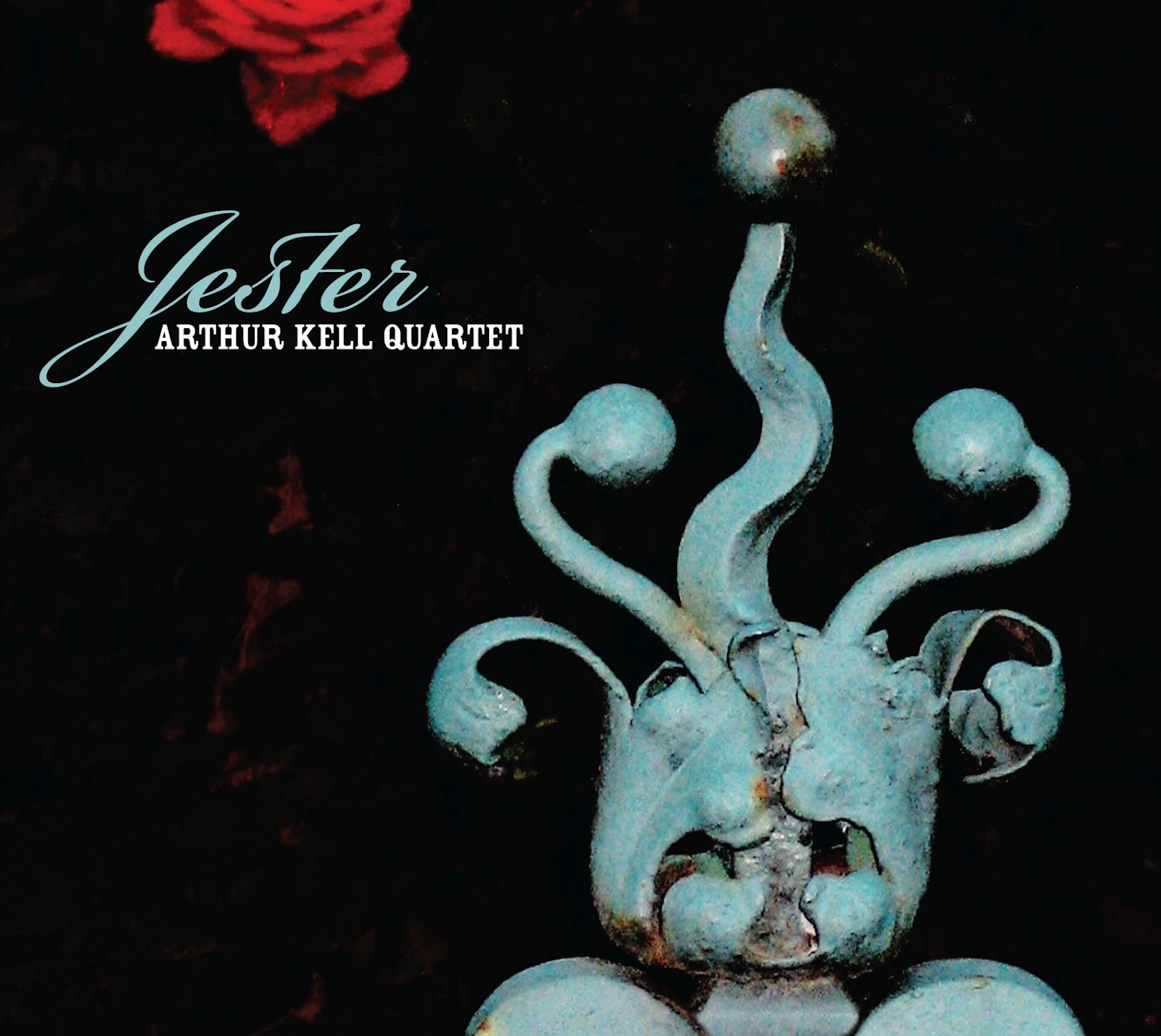
KIRPAL GORDON: I’m intrigued with the cover art of Jester as much as I am the cover art to Traveller. The image seems so emblematic of the music.


ARTHUR KELL: Itinerant musicians traveling from town to town for live performance, it’s an age-old role. But musicians and artists generally occupy a precarious and profoundly interesting spot in society. They can be adored, reviled, distrusted and considered indispensable in short order, depending on the audience. They can occupy both the highest and the lowest rungs of societal honor and respect. That’s why the jester image made so much sense to me. Although their age has passed historically, they represent the same remarkable and challenging role. If you dig past the common and shallow idea of jesters as silly people, you find out that jesters were present world-wide and in every conceivable role at the center of society: entertainer, closest friend of the ruler, powerful political advisor, idiot, comedian. In many situations, they represented free-speech in a constricted society. Because their social standing was the lowest, they could say what others could not say. They allowed a king and a court and a society to develop its ideas after listening to the “worthless fool.” They were like imagination in action, with all of the curiosity and questioning perspective of the person who is not part of normal society. It’s hard not to draw a line between artists of today and jesters of yesteryear. I feel like a quirky, weird, imaginative, curious jester. If my music captures that spirit then even better.
Also, there’s the fact that the jester on the cover is an iron jester. In many societies, blacksmiths are feared and shunned. An iron jester is a reflector of society created by an artist using a hell-like fire. To make it even more diabolical, he’s also kind of cute and very funny. He’s anything your fear or hope could create.


KIRPAL GORDON: You’re onto something about the jester’s gestures. Wavy Gravy (a/k/a High Romney) said he took more than a few beatings when he dressed as a fool back in the Merry Prankster era but never got roughed up playing the clown in America. Back to your music, between the release of Jester and Traveller is Victoria---Live in Germany, of which Matt Marshall wrote in Jazz Improv Magazine, “Everything that modern jazz should be: vibrant, challenging music from a band so tight within its group dynamic and so confident in its individualistic chops that every movement is a lively step forward. The recording retains all of the energy of a kick-ass live event and should receive serious album-of-the-year consideration.” All About Jazz said, “...exquisite solo moments, but the music’s lyrical bent and the quartet’s collective talent for nuance is what brings this disc home...the sense that these are stories never wanes...the results are very, very good." Something Else accused you of being “a no-nonsense bass player with a lot of range.”
        How do you stand on all of these charges?


ARTHUR KELL: Thankful! Thankful that anyone is understanding my intent.


KIRPAL GORDON: What’s the story behind your earlier CD, See You In Zanzibar? Is that a pun on Bing and Bob or is this the result of your own travels through Africa with Thomas Chapin? You had played in one of his great quintets, Spirits Rebellious?


ARTHUR KELL: It’s all about travel with Thomas and a metaphor for our lives and after. We spent a lot of time together starting in high school, really from age 15 on. More than anyone or anything else, he instilled in me a belief in extraordinary things. His sheer force of will and musicality and humor made me want to be a musician and capture the beauty inherent in life. He kept leaning on me to join him in Africa in 1997. I finally decided to meet up with him in Tanzania and flew out of New York expecting to travel together for two weeks. We were both Africaphiles and were hungry to be there. Through friends we arranged to meet on Zanzibar island (email and cellphones were uncommonly used back then). When my boat came in and we met at the dock, he didn’t look well. We barely left our hotel rooms for a week and then we got him back to the airport and he went home early. Long story short, he had leukemia and died a year later. The cd title is taken from the ballad I wrote for him. I love that track. We really captured something special, something he deserved.


KIRPAL GORDON: In addition to composing, band leading and touring, you are also quite the sideman around town, a bassist for an incredible range of players and projects. How long has this been going on?


ARTHUR KELL: I’ve been doing sideman work as long as I’ve been in New York -- for decades. God willing, it’ll be decades more, I love being a sideman!


KIRPAL GORDON: I understand you’ve recently made some trips to India.  And you’re doing some teaching of jazz there? Is this related to your study of yoga or mindfulness meditation?


ARTHUR KELL: I’ve been once so far, mostly to Kerala. I’m going back this fall to teach electric bass at the Swarnabhoomi Academy of Music outside of Chennai for seven weeks. It’s not related to yoga and meditation and just came about through a musician friend’s recommendation. I’m excited to be there and working in a different environment for a change.


KIRPAL GORDON: With all the things you do, how did you ever find time to be an environmental activist for NYPIRG? I remember the heading on Good Morning America on ABC-TV: Arthur Kell On the Arthur Kill.


ARTHUR KELL: There was about seven years there where I became completely consumed in that public interest work. I don’t know if there is any other way to do it well. I became a full-time activist and hardly kept up with being a musician. I never intended to get so involved but it was an incredible experience and a great way to see how New York City operates – from City Hall political hardball to community meetings on Staten Island. I learned so much about law, economics, organizing, public speaking and dealing with the media. It gave me a wide-angle view of society and politics and how change is affected. And it answered a call I had to make a very direct contribution to the community in which I live. But eventually I had to come back to music full-time. And when I did, my composing was a lot more interesting than it was before.

KIRPAL GORDON: So what’s going on in Bed-Stuy? Are there more jazz musicians and composers living in Brooklyn now than Manhattan?


ARTHUR KELL: Bed-Stuy is an amazing area and living here just feels like a natural extension of all the years I lived in Fort Greene. It’s hard to believe it’s 32 years now in both places. Of course, I love all things Brooklyn. I was out here in Bed-Stuy and Crown Heights in the early 80’s when bars like Tiffany’s and Brownie’s and the after-hours joints were happening. Although it was long past Bed-Stuy’s jazz heyday, the crowds would be so into the music, they knew it so well. A couple of years ago, an older cat tried to get my attention as I was rushing off to a gig and trying to get my bass into the car. You know, the usual, “Hey I play music, too.” But he started running down the history of jazz in Bed-Stuy in the Fifties and it became obvious that he knew exactly what he was talking about: “Tommy Potter lived over there on Jefferson….” He went through Miles’ bands. Then he said, “Monk used to come out and do sessions right over there…” He pointed to a building just up the street.


KIRPAL GORDON: In the arc of history that this music has traveled, where do you see things headed now?


ARTHUR KELL: To me, the music scene is much as it has always been: bursting with creativity and dedication and not enough places to play. There are musicians arriving in this city every day who are completely committed to their art. They will find a way to keep their music alive.


KIRPAL GORDON: How can people at Giant Step Pres blog stay in better touch with all of what you do?


ARTHUR KELL: My website lists a lot of what I do: www.arthurkell.com. I’m also on Facebook.