I
spoiled God’s divine plan at the age of 17. My mother was shouting at me to not
throw a bucket of water at my sleeping brother, yet I did. As expected, she was
as enraged as was my brother, but he’s not important for now. My mother, or
rather her beliefs as a Hindu, however, are. According to Hinduism, God has a
divine plan for the world and everything that happens in a human’s life happens
for a reason that only They know. Hence, it is often preached that one should
not give into rage because all bad things are Their plan. If one reads again
closely, they will find that I was able to aggravate a firm believer of this
notion. I had her, just for a moment, “step away from God” and commit a sin.
That possibly wasn’t part of his plan. I beat God…or did I?
Later
that year angering my mother became a second habit, and questioning Their
existence became the first. That was because I had concluded at this point that
there was no divine plan that we followed. Call me skeptical but I fail to
understand why the plan called for people to die at the hands of others for
money. If there was a God, would he make a plan that could lead to this? Though
I did know the answer already I wanted confirmation, which I found in Alan
Watts’s The Book: On the Taboo against
Knowing Who You Are. He confirmed my suspicion in the very first chapter by
saying:
God also likes to play hide-and-seek,
but because there is nothing outside God, he has no one but himself to play
with. But he gets over this difficulty by pretending that he is not himself.
This is his way of hiding from himself. He pretends that he is you and I and
all the people in the world, all the animals, all the plants, all the rocks,
and all the stars. (Watts)
Hindu
philosophy states that we are born of God and we are one with Him. Watts
seconds this notion by stating “there is nothing outside God.” Ergo, inhabitants of the
earth, we all collectively are God! He is more you and more I than he is in
Himself. The fog dissipated at last, giving way to why the divine plan led us
to an era where the majority is not happy to be alive.
“… Sometimes
the reason is you're stupid and make bad decisions.” (Harmon)
Being
the Devil’s advocate, or maybe the God’s advocate, I started questioning
priests and learned people about whether they knew God or not. More
importantly, had God given them what they asked for any more than their parents
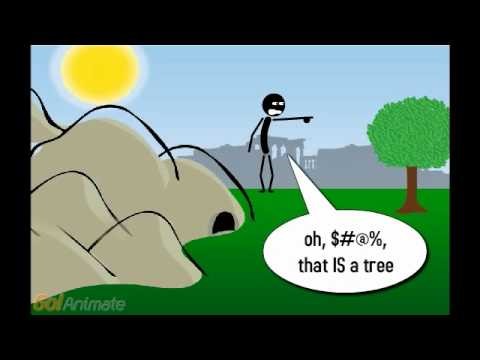
or friends did? Before the big reveal, however, it is important that one knows about Plato’s Allegory of the Cave.
Consider a bunch of
prisoners who were chained up in an underground cave ever since birth. Their
only sources of light are the diffused sunlight coming from the mouth of the
cave and the fire burning behind them at a higher elevation than them. From in
front of the fire passes a road where showman and puppeteers perform casting a
shadow on the opposite wall, the only wall that prisoners can see. Since that
was the only thing they saw since the beginning of their lives, the prisoners
accept the shadows to be true and hence start naming and familiarizing with
them. If from a bunch of these prisoners one random person was freed and shown
his surroundings – the fire and the diffused sunlight – he would start
questioning his conception of reality.

Illuminated by this new knowledge, the prisoner
returns to the cave to help his fellow prisoners differentiate the true from
the shadows. Before making a decision, I would like you to try and remember
your reaction when you figured out your mother’s name was not “mom,” or some other
variation of it, but rather something else. I, personally, did not accept the
fact and it took a lot of explanation to reconcile me. Or, try telling somebody
that cockroaches cannot harm them and do not need to be feared. If one can be
unaccepting of such minor changes, it would come as no surprise that the
prisoners did not want to believe the free man. Since his eyes were more
adapted to light, he could not see the shadows of the cave properly whereas the
other prisoners could. They used that fact to establish their superiority and
shunned him aside like a lunatic. The prisoners in this case could be exchanged
with the priests I talked in my quest for sun.
Some debated with me back and forth and
strengthened my point that God resides in all of us, and prayer is just a way
of reminding oneself what’s important to them in life. Others entered a state
of absolute denial or even became a little hostile with their words and called
me the personification of blasphemy.
Societal pressure, however, did not stop my
investigations. I had progressed to finding the meaning in every mundane aspect
of life: each blink, each wink, the flutter of the bees that I now consider my
equal, each breath we take. The last question popped up to me during my
grandfather’s funeral. He was clinging to life with an oxygen mask as
Alzheimer’s took away his ability to breathe. My uncles and father gathered
around him and were showing him images of the deity he worshiped and whispered, “They are calling you. You want to go to Them, right? You can go.” Among the
loud sniffles, cries, and wailing, this sentence rang loud in my mind. If one
believes in living a better life after death, why do they fear it or get sad
when a close one dies?
“Has any one supposed
it lucky to be born? I hasten to inform him or her it is just as lucky to die…” (Whitman)
Walt Whitman’s 52-piece series called “Song of Myself” covered most of what I
would like to know about life. It is true that the way I assimilate the message
may be radically different than what he intended, but it resolved my issues. From Song
1, “I celebrate myself, and sing myself…,” I learned what it truly means to
live and bask in the glory of oneself while enjoying the moment. Song 6 talks about leaves of grass, affirming oneness among humans and the earth; all
of us being part of the same, being born and dying to be the same. Why should I
then treat anything or anybody any different than others? The grass I walk on
is not less deserving of my respect than the stranger I share a smile with at
the coffee shop. My reaction on my phone falling out of my pocket and breaking
must not differ from when I found out it was just my tempered glass protector. Some
people mistake this for my apathy, but I am merely taking things as they come,
like the Chinese farmer.
The Chinese farmer, in Alan Watts’ The Story of the Chinese Farmer, as one
may have guessed by now, was a statute of the Buddhist principle of impermanence with an eye to the tao (zen). When dealt
with seemingly good or bad situations, the farmer stays calm and waits for them
to play out on their own, much like Arjuna learns in the Bhagavad Gita, that is, non-attachment to the fruits of one's actions. Divergence of the actual outcome from our
expectations is what causes our sadness and not the outcomes themselves. This
happens to be an unrealistic thing to chase after, but we all hope for a
miracle every day.
Through my journey of life till now, I have been
transformed into an atheist who does not believe in god, but after being
acquainted with Alan Watts and Plato, I believe in humans and our power to
change our lives as well as others. Hence, I would rather say that I am non-theistic but still pursuing truth. I believe in questioning what I see and am
told to believe without reason. Walt Whitman gave me new questions to think
about and a new perspective to view things from. The Chinese farmer challenged
me to not over-think too much and to take things as they come. I was resolved and
challenged to break the shackles and go to the light, to stand at the edge of
the cave and learn about all the new parts of me that I see and not be
overwhelmed by it. I have a new rail to take my train of thought on, and this
is the last call. All aboard!
Works
Cited
Clay, Becky. “Plato’s
Allegory of the Cave.” YouTube. 5 Jun.
2011, https://www.youtube.com/watch?v=RoOVFO4Qnqg&feature=share.
Dhyani, Divya. Haridwar.
Jan. 2015.
Harmon, Marion G., Ronin Games, Vol. 5. USA: CreateSpace Independent Publishing Platform, 2015. Print. 6
vols.
Living, Raw. “Plato’s
Allegory of the Cave in Cartoon!” YouTube.
4 Nov 2014, https://www.youtube.com/watch?v=J0GLmYm-SRw
Plato. Allegory of the Cave. Trans. Jowett, Benjamin.
Los Angeles: Enhanced Media Publishing, 2017. Print.
Plato. Great
Dialogues of Plato. Edited by Eric H Warmington and Philip G Rousse.
Translated by W. H. D. Rouse. New
York: Signet Classics, 1999. p. 316
Watts, Alan. Chapter 1
“Inside Information.” The Book On the
Taboo Against Knowing Who You Are. Aylesbury: Hazell Watson & Viney Ltd,
1973. Xvii. PDF
Watts, Alan. “The Story of
The Chinese Farmer.” YouTube. 20 Nov 2016. Web. 02 Dec. 2018.
Whitman,
Walt. Song of Myself. Dover
Publications, 2001. Print.